

You read the listing. You checked the star rating, 4.4 stars from over a thousand reviews, not bad at all. You looked at the flow rate, 2700 gallons per hour, which sounded more than sufficient for your pond. Then you ordered it, it arrived in two days, and you took it outside with a cup of tea and a sense of optimism. And that is roughly where most reviews end. Mine is going to start there.
I have been keeping koi for thirty-one years. I have run submersible pumps through more seasons than I care to count, and I have learned that the honest part of any equipment review happens not in the first week but in the sixth month, when the novelty has worn off and the small daily realities have made themselves known. This is that review. It covers what the listing does not say, what the star rating cannot capture, and a few things I genuinely wish someone had told me before installation day.
The Quick Verdict
A capable, well-priced pump that earns its place in a mid-sized pond, but only if you go in with accurate expectations about running costs, filter maintenance frequency, and the not-quite-complete installation kit.
Amazon Check Today's Price →If your pond has no circulation right now, your koi are already under stress
The VIVOHOME 120W 2700GPH pump is one of the more straightforward fixes at this price point. See today's price before you read any further, then come back and I will tell you exactly what to expect once it arrives.
Amazon Check Today's Price on Amazon →What Nobody Tells You About Installation Day
The box arrives and the pump looks the part. Solid black housing, a satisfying heft to it, the cord is a reasonable length at about ten feet. You pull out the instructions and this is where the afternoon begins its quiet slide sideways. The instructions are not bad, exactly. They are just thin. A single folded sheet, diagrams that are competent but small, and no mention of a few things that matter considerably.
First: the outlet fittings. The pump comes with two adapters, one for 1.18-inch pipe and one for 1.57-inch pipe. What it does not come with is any pipe. If you are connecting this to an existing filter system, measure your current return pipe before you open the box. I assumed the larger adapter would fit my existing setup. It did not. A second trip to the garden centre, forty minutes each way, was not how I had planned that Saturday.
Second: the suction cups. There are four of them, and they are supposed to hold the pump off the pond floor. They grip adequately on a smooth liner. On a textured liner, on stones, on the concrete base of an older pond, they grip rather less adequately. My pump shifted within the first week. It is not catastrophic, but a pump lying on its side draws debris differently than one sitting upright, and it took me a little while to realise why the pre-filter was clogging faster than expected. A flat slate tile underneath the pump solved it immediately. Worth knowing in advance.
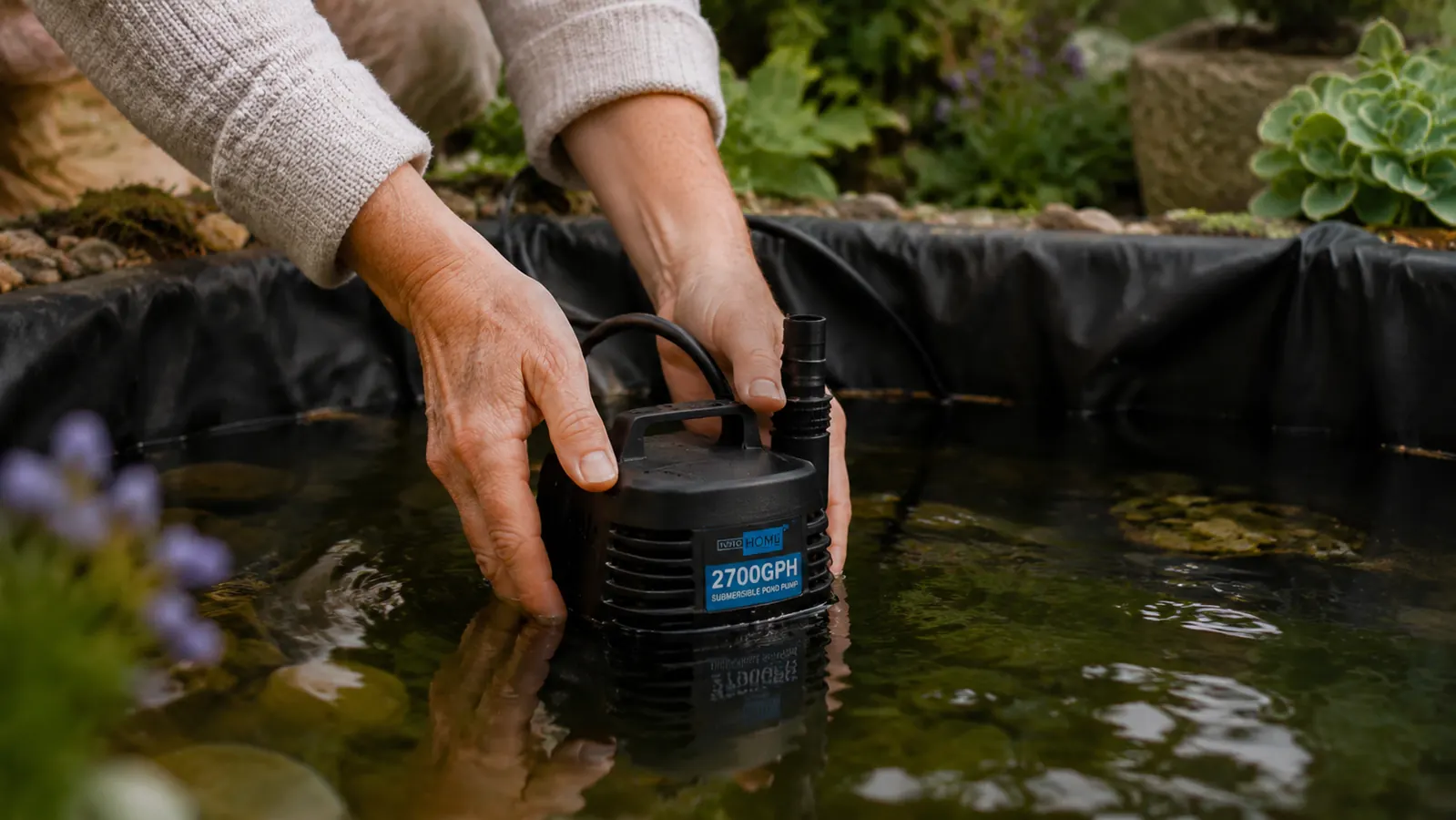
Third, and this is the one that surprised me most: the cord exits the pump at the top, which is sensible for waterproofing, but it means you cannot lay the pump flat against a vertical surface or tuck it into a corner without the cord creating an odd angle. It is a minor thing. But in a small or heavily planted pond where you are trying to hide the pump, it adds a constraint you do not know about until you are elbow-deep in cold water at six in the evening.
The Running Cost Maths That the Listing Skips
The VIVOHOME 120W draws 120 watts continuously. That is not a flaw, it is simply what a pump of this flow rate requires. But I want to be direct about what 120 watts means over a full season, because most reviews mention wattage and then move on without doing the arithmetic.
Running a 120W pump for 24 hours uses 2.88 kilowatt-hours per day. At an average residential electricity rate of around 13 to 15 cents per kWh, and rates vary considerably by region, that comes to roughly 37 to 43 cents per day. Over a full year of continuous operation, which is what a koi pond requires in all but the coldest climates, you are looking at approximately 135 to 157 dollars added to your electricity bill. Call it 145 dollars a year as a working figure. Over three years, the pump's lifetime cost is the purchase price plus around 435 dollars in electricity. That changes the value calculation considerably.
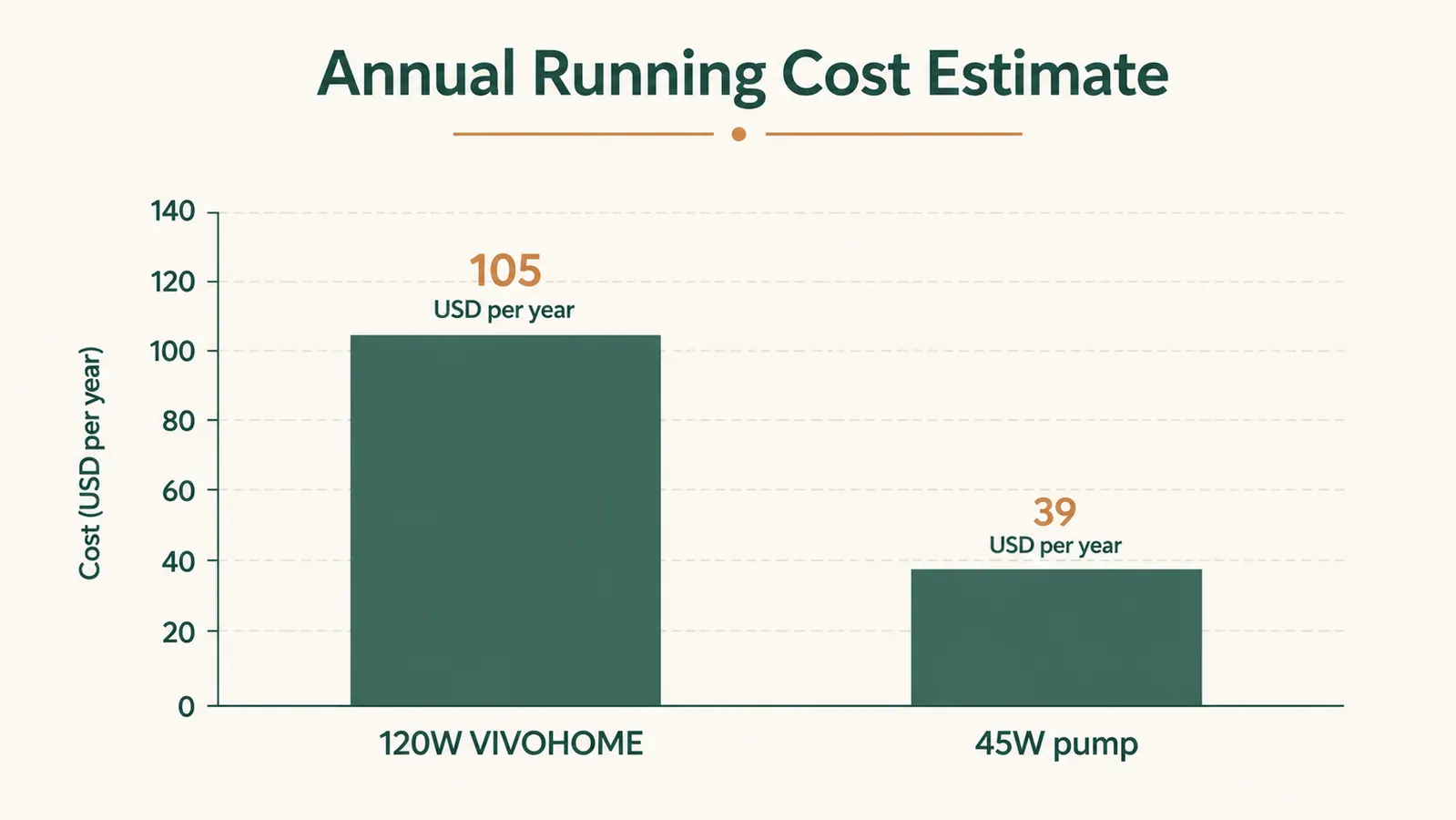
This does not make the VIVOHOME a bad choice. At its price point, the flow rate is excellent, and a koi pond genuinely needs that volume of water moved to keep dissolved oxygen where it should be. But if you are replacing a 45-watt pump and expecting similar running costs, you will be surprised when the electricity bill arrives. A 45-watt pump running continuously costs roughly 51 to 59 dollars per year. The VIVOHOME costs more than twice that. Know this going in and it stops being a surprise.
The purchase price of a pond pump is really just the entry fee. It is the electricity cost that you live with every single day for the next three to five years.
The Filter Foam: More Honest Than the Product Listing
The pump includes a pre-filter foam sponge that sits around the intake. It is functional and the right density for the job. What is not stated clearly is how often you will need to clean it in an active koi pond. With six koi between 12 and 18 inches, I was cleaning mine every four to six days in summer. Every four to six days. Not once a month. Not once a fortnight. Twice a week, sometimes.
Koi produce a considerable amount of waste. In warmer water, algae and debris accumulate faster. A partially clogged pre-filter dramatically reduces the pump's effective flow rate, you can watch your waterfall slow to a trickle if you miss a week. This is not unique to the VIVOHOME; it is true of any submersible pump with an intake sponge in a koi pond. But some products mention it. This one does not, and first-time pond keepers in particular can end up confused when the pump appears to be losing performance after a month.
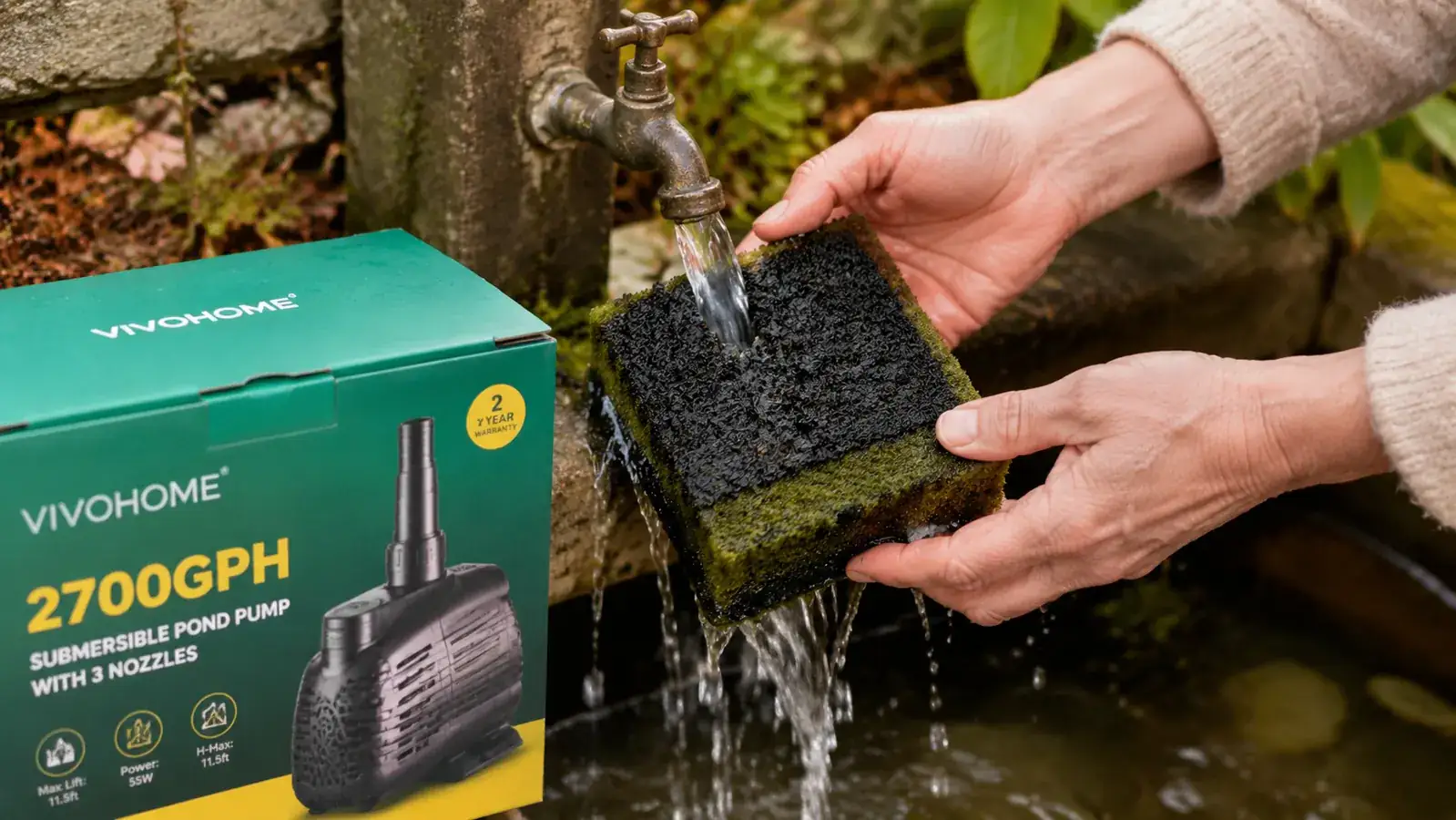
The practical solution is to keep a spare foam block so you can swap one in while the other is drying. The VIVOHOME sponge is a standard size and replacement blocks are easy to find, which is genuinely a mark in the product's favour. Some pumps use proprietary pre-filter shapes that are difficult to source. This one does not. But you will be sourcing spares sooner than you think.
The Noise Question: Honest, Not Promotional
Many reviews describe this pump as quiet. I would describe it as acceptable. There is a difference. Submerged fully in at least 18 inches of water, with the water noise from a waterfall or fountain head covering the background hum, you will not find it intrusive. If your pond is shallow, if the pump is sitting close to the surface, or if your garden is otherwise very still on a summer evening, there is an audible low-frequency vibration that travels through the water and sometimes through the pond edging.
My pond is 24 inches deep at its centre and the pump sits at around 20 inches. At that depth, with a small waterfall running, I do not hear the pump. My neighbour, who has a shallower wildlife pond and placed her borrowed VIVOHOME close to the surface during a trial, found it noticeably louder than she expected. The pump itself is not defective in either case. The physics simply vary with depth and installation.
Where the VIVOHOME Genuinely Earns Its Stars
I want to be fair, because this is an honest review and not a complaint letter. The VIVOHOME 120W has run continuously in my pond for seven months without any mechanical failure. The impeller has not stuck. The seal has not leaked. The cord connection point, which is a common failure spot on cheaper pumps, has remained dry. For a pump at this price, that is not nothing.
The flow rate is genuine. When I tested it by timing how long it took to move water through a marked section of my waterfall, the output matched the rated figures closely enough to be reassuring. Some budget pumps claim one flow rate and deliver another. This one delivers what it says, and in a koi pond that matters because adequate circulation is not optional, it is the difference between healthy water chemistry and a struggling tank.
The adjustable flow control is also more useful than I expected. There is a dial on the body that lets you reduce output without switching off the pump entirely. In early spring, when my koi are still sluggish and the biological filter is ramping up, running the pump at roughly 60 percent flow puts less turbulence in the water while still maintaining circulation. I use that setting every March and April.
What I Liked
- True 2700GPH flow rate that matches the listing
- Adjustable flow dial gives real seasonal flexibility
- Solid mechanical reliability across seven months of continuous use
- Standard pre-filter foam size makes replacements easy to find
- Two outlet adapters included cover most common pipe sizes
Where It Falls Short
- No pipe included, plan for a separate garden centre trip on installation day
- Suction cup feet unreliable on anything other than smooth liner
- 120W draw means roughly 135 to 155 dollars per year in electricity
- Pre-filter requires cleaning every four to six days in a stocked koi pond
- Cord exit position limits placement options in small or heavily planted ponds
The Small Things That Only Show Up After Six Months
Here is the section I most wanted to read before I bought mine, and could not find anywhere. Six months in, these are the small realities: the pump body accumulates a mineral deposit ring at the waterline if the water level in your pond fluctuates seasonally. It scrubs off without much trouble, but it takes elbow grease. The black housing shows algae growth more visibly than lighter-coloured housings might, which is purely aesthetic but does make the pump look older than it is when you lift it for cleaning.
The flow adjustment dial can become slightly stiff after extended use. It still turns, and it still adjusts the flow, but the smooth click I noticed in the first weeks has become a minor effort. Again, not a failure, a wear characteristic. And the power cord, while adequately long at ten feet, ends at a standard two-prong plug rather than a grounded three-prong. If your outdoor socket requires a ground connection, you will need an adapter. This is a minor point but one I have seen catch people off-guard.
None of these things would make me return the pump. They are the honest texture of daily ownership, and I think any review that does not mention them is giving you an incomplete picture.

Who This Pump Is Really For
The VIVOHOME 120W 2700GPH is the right pump if you have a pond of roughly 1,000 to 2,000 gallons, you are keeping a moderate number of koi or goldfish, and you want solid performance at a price that does not require a second mortgage. It is also right for you if you do not mind moderate maintenance involvement, if cleaning a foam block every few days feels like part of the pleasure of pond keeping rather than a chore, this pump will serve you well.
It is less suited to you if you are hoping for something that runs itself, if your electricity costs are already a concern, or if you are working with a very shallow pond where the pump will sit close to the surface. In those cases, a lower-wattage pump matched more carefully to your actual pond volume may serve you better over the long run, even if the upfront flow numbers look less impressive.
Who Should Look Elsewhere
If you have a small ornamental pond under 800 gallons with a handful of goldfish, the 2700GPH flow rate is likely more than you need and the 120W draw is more than you should pay for. A 45-watt to 65-watt pump will circulate that volume adequately, cost roughly half as much to run annually, and create less turbulence in a smaller space. Koi and goldfish are hardier than we sometimes think, but they do not enjoy being pushed around by a pump sized for a pond three times the volume of their home.
Equally, if you have a very large pond over 3,000 gallons with a heavy fish load, the VIVOHOME may be the minimum rather than the right choice. At that scale, running two smaller pumps gives you redundancy, if one fails, your fish are not immediately in danger while you source a replacement. A single pump, however good, is a single point of failure.
Seven months of honest running later, I would still recommend it, with eyes open
If your pond is between 1,000 and 2,000 gallons, your koi need reliable circulation, and you want a pump that does what the listing claims, the VIVOHOME 120W is a reasonable choice at today's price. Factor in the running costs, buy a spare foam block, and take a piece of slate to set it on. You will be fine.
Amazon Check Today's Price on Amazon →If there is a single thing I would most want you to take from this review, it is this: read the wattage and do the annual electricity maths before you click buy, not after the first bill arrives. Everything else about this pump is fixable with a bit of preparation. That ongoing cost is just the reality of keeping a well-oxygenated pond, and the sooner you factor it in, the easier it is to make a genuinely informed choice for your fish and your garden.