

I have kept koi since before some of my neighbours were born. In that time I have owned ponds of every size, fed fish through bitter winters, and watched water quality charts with the sort of attention most people reserve for stock markets. I have also buried three pond pumps that failed exactly when my fish needed them most: two in the heat of summer and one in February, when I came out to find the surface had stopped moving and my oldest kohaku was gulping at the edge. So when I say I approached the VIVOHOME 120W 2700GPH submersible pump with a great deal of scepticism, I mean that genuinely. I am not easily impressed, and I am not looking for things to praise.
What I can tell you, after running this pump continuously through two full seasons in my 1,800-gallon garden pond, is that it has earned its place on the bottom. It is not the quietest pump I have owned, and the instruction manual reads as though it was translated by someone who has never seen a pond. But it has not stopped. Not once. And for a woman who has lost sleep over pump failures, that matters more than I expected.
The Quick Verdict
Reliable workhorse at a fair price. Rougher around the edges than premium brands, but two seasons of uninterrupted service is hard to argue with.
Amazon Check Today's Price →If your koi are gasping at the surface in warm weather, your pump is not moving enough water.
The VIVOHOME 2700GPH handles ponds up to around 2,700 gallons and powers waterfalls or external filters without complaint. Two seasons of daily use. Still running.
Amazon Check Today's Price on Amazon →How I Have Used It
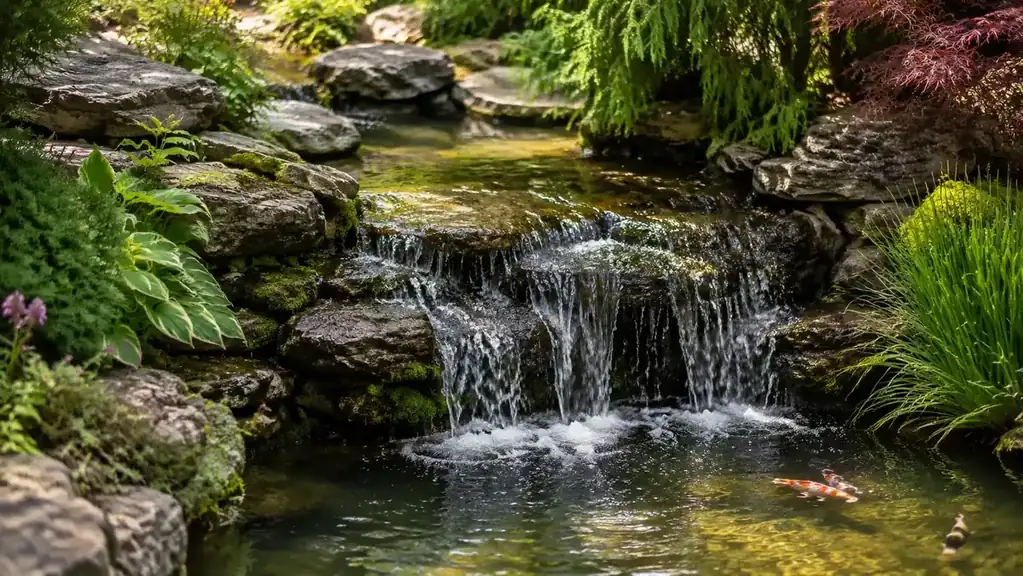
My pond sits in the south-facing corner of the garden, which is both its best feature and its greatest challenge. The koi love the warmth and so does algae. The pond holds roughly 1,800 gallons, is about four feet at its deepest point, and is home to nine koi ranging from a small eight-inch kohaku I bought last spring to a twenty-two-inch showa who has been with me for eleven years. I run a pressurised external filter fed by the pump, and the return line drops into a small waterfall feature that I built from reclaimed limestone.
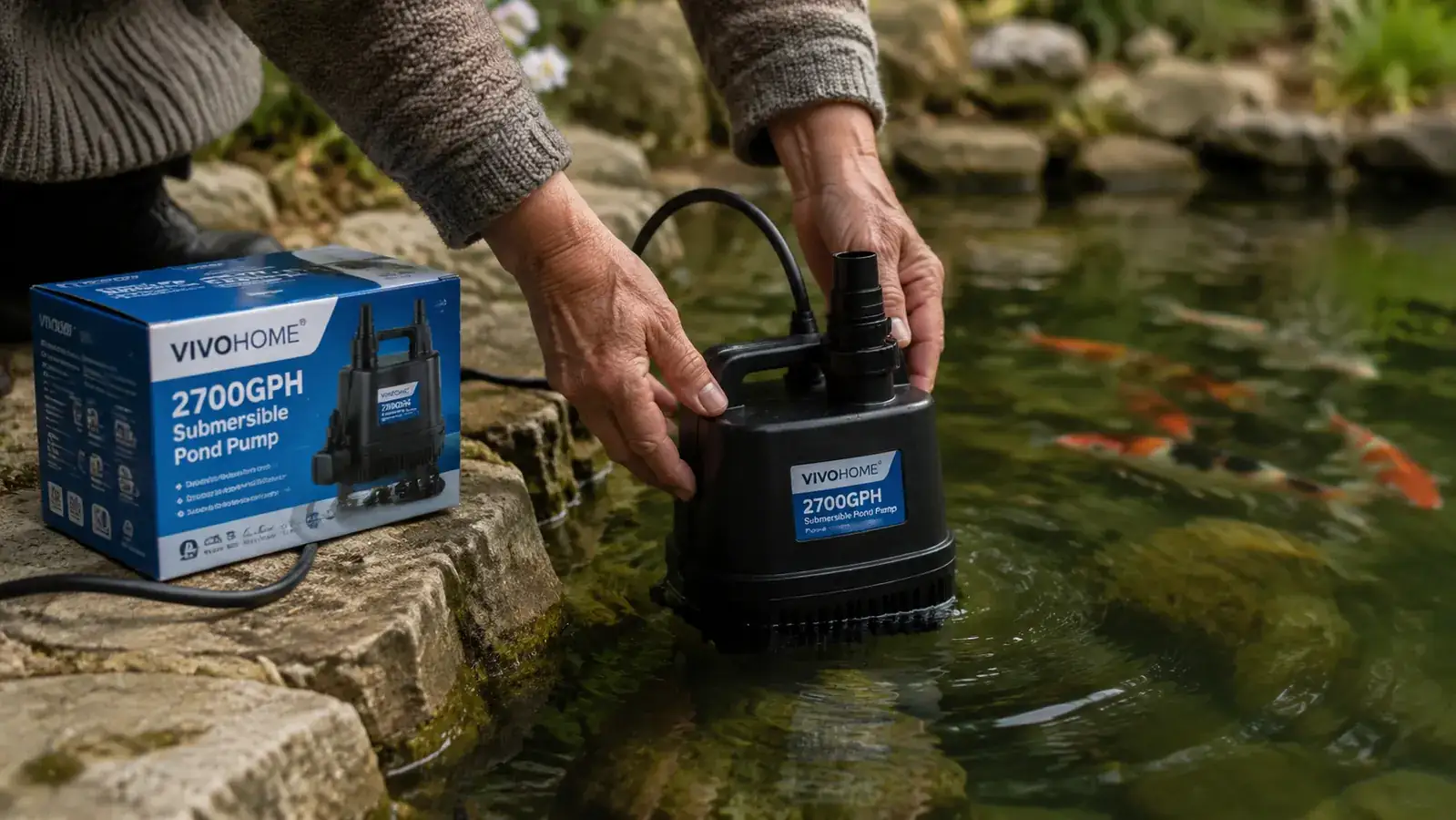
I placed the VIVOHOME pump in April two years ago, after my previous pump, a mid-range European brand I will not name, gave up the ghost in its third season. The VIVOHOME went in at the deepest point of the pond, positioned away from the intake of my filter to encourage circulation rather than just a loop. I set the flow adjuster to roughly three-quarters open and have left it there ever since. The only time it came out of the water was for the winter months, when I drained the filter line and switched to a smaller, dedicated aeration pump to keep a hole in the ice.
The first thing I noticed was the water clarity. Within ten days the pond was visibly cleaner than it had been at the end of the previous season. Whether that was the new pump or the new season I cannot say with complete certainty, but the flow rate was noticeably stronger than what I had been used to, and the waterfall sounded properly alive again rather than the tired trickle I had grown resigned to.
What the Specifications Mean in Practice
The VIVOHOME runs at 120 watts and is rated for 2,700 gallons per hour at zero head. Head pressure matters here because that figure drops as you push water upward or through a filter. My filter and waterfall combination creates roughly four feet of head, which brings the real-world flow rate down to somewhere around 1,800 to 2,000 GPH, depending on how clean the foam pre-filter happens to be. For my 1,800-gallon pond that is a complete turnover slightly under every hour, which is the minimum I would want for koi.
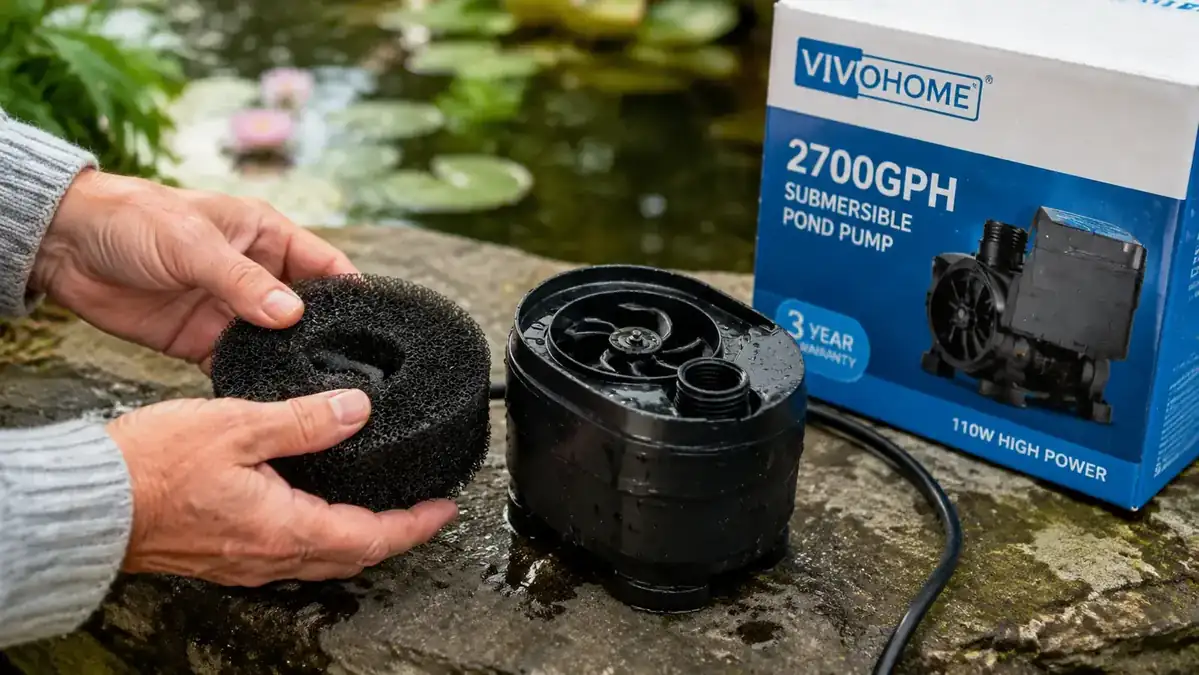
The pump body is made of hard plastic with a fine mesh cage around the impeller and a removable foam pre-filter around that. The foam catches leaves and string algae before they reach the impeller. I clean it every three to four weeks in summer and every six to eight weeks in cooler months. It takes about four minutes and requires no tools. The impeller itself has been easy to access the two times I have checked it, though I found a small piece of leaf debris lodged against the blades in the second summer, which I attribute to being careless about cleaning the pre-filter after a particularly windy week.
The power cable is ten feet long, which was almost exactly right for my setup. Some reviews mention wishing it were longer. If your power source is more than eight feet from the pond edge you may need an extension, and you should use one rated for outdoor use and elevated from the ground. This is not a criticism of the pump itself, but it is worth planning for before you buy.
Performance Through a Hot Summer
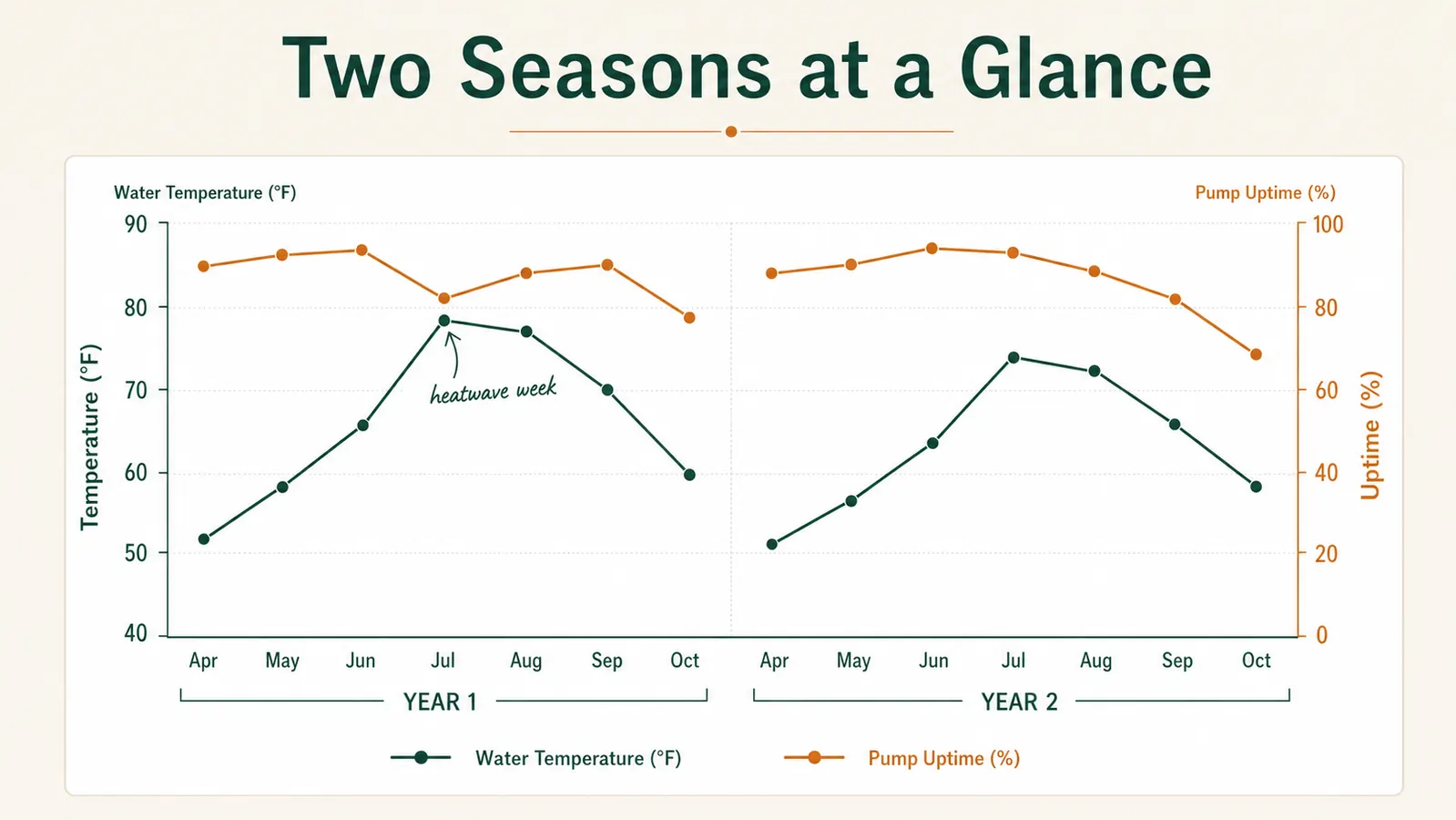
The first test of any pond pump is a genuine heatwave. We had a stretch of nine days in my second season where temperatures sat in the low nineties. Pond water was reaching seventy-eight degrees Fahrenheit, which is the point at which dissolved oxygen drops fast and koi begin to show stress. I topped the pond up each morning with dechlorinated tap water to help cool it slightly and I watched the fish carefully. Not one showed stress. The waterfall was moving well, the surface was broken, and the pump ran without issue through every one of those nine days.
I have read reviews from people who say their unit ran warm to the touch during extended summer use. I checked mine several times during that week and the housing was warm but not uncomfortably so when I put my hand in the water. The manufacturer's guidance says the pump is designed to run continuously, and my experience supports that claim. It did not pause, cavitate, or reduce its output during the heat.
The first summer heatwave is when you find out what your pump is really made of. Nine days of ninety-degree weather and it never flinched. That is the thing I remember most.
Noise: What to Expect Honestly
I want to be straightforward about this because several reviews describe the VIVOHOME as silent and it is not. It is quiet by the standards of older pumps, but if you sit within six feet of your pond on a calm evening you will hear a low, steady hum through the water. It is not obtrusive. It is the kind of sound that fades into the background after ten minutes. But if you are hoping for absolute silence you will notice it, at least for the first few weeks.
The noise level has not changed between seasons, which suggests the bearings are holding up well. A pump that gets louder over time is one that is wearing out, and this one sounds the same in month twenty-four as it did in month one. That is genuinely reassuring.
Energy Use Over Two Seasons
At 120 watts running continuously, this pump consumes roughly 2.9 kilowatt-hours per day. At current electricity prices that works out to a meaningful sum across a full season, and it is worth being honest about. Running a pump is not free. If energy cost is a serious concern for you, there are variable-flow pumps that adjust their output to conditions and can reduce consumption significantly, though they come at a higher purchase price.
What I can say is that the VIVOHOME's consumption is in line with what I expected from a 120-watt motor. It is not inefficient for its output class. You are not wasting power unnecessarily. If you want the same flow rate for less energy, you will need to spend considerably more on a premium European or Japanese motor. For many pond keepers, the maths on that does not work out in favour of the expensive option.
Installation and What the Manual Does Not Tell You
The pump comes with a collection of adapter fittings for different hose sizes, which is thoughtful. My filter inlet takes a one-and-a-quarter-inch hose and one of the included adaptors fitted it without any modification. The flow-rate dial on the back of the unit adjusts through a satisfying range and the mechanism feels solid rather than flimsy.
The manual, however, is thin and assumes rather a lot. It does not explain where to position the pump within the pond for best circulation, it does not mention the importance of keeping the intake away from silt at the bottom, and the guidance on cleaning intervals is vague. If you are new to pond pumps I would strongly recommend reading a few reputable pond-keeping guides before installation rather than relying on the included instructions. The pump itself is forgiving, but poor placement will reduce its effectiveness considerably.
For anyone wondering about winterising: I remove this pump in November and store it in a bucket of water in the garage to prevent the seals from drying out. This is standard practice for submersible pumps and the VIVOHOME benefits from it. I replace it in April once the water temperature is consistently above fifty degrees.
What I Liked
- Ran continuously for two full summers without stopping or slowing
- Real-world flow rate adequate for ponds up to around 2,000 gallons with a filter and waterfall
- Pre-filter foam is easy to remove and clean without tools
- Included hose adaptors covered my filter connection without modification
- Flow adjustment dial has a wide and genuinely useful range
- Has not grown louder over twenty-four months, suggesting bearings are holding
Where It Falls Short
- Not silent: a low hum is audible close to the pond surface on calm evenings
- Manual is poorly written and offers little practical setup guidance
- 120 watts is not the most energy-efficient option at this flow rate
- Power cable length may fall short for some pond configurations
- Plastic housing feels noticeably less substantial than premium-brand alternatives
How It Compares to What I Used Before
Before the VIVOHOME I used a pump from a well-regarded European brand that cost nearly twice as much. It was quieter, the build quality was obviously superior, and the instruction booklet was translated competently. It also developed a bearing fault in its third season and had to be replaced. The VIVOHOME cost me significantly less and is now in its third season without fault. I am not drawing a firm conclusion from that comparison, but I am noting it.
The TetraPond pump is probably the most common alternative at a similar price. I have a full comparison if that is useful to you. The short version is that the TetraPond is slightly quieter but runs at a lower flow rate for the same wattage. For a smaller pond without a waterfall it is worth considering. For anything over 1,200 gallons with external filtration I would choose the VIVOHOME's flow rate. You can read the full breakdown in my VIVOHOME vs TetraPond comparison.
Who This Pump Is Right For
This pump suits the pond keeper who has a garden pond between 800 and 2,500 gallons, runs an external pressure filter or box filter, and wants a waterfall or fountain feature as part of the return. It will handle that job reliably and without drama. It is particularly good value if you are replacing an older pump that has finally given out and you want dependable service without paying premium-brand prices.
It is also a reasonable choice if you are setting up your first koi pond and want to learn what you need without committing to expensive equipment before you understand your own pond's requirements. After a season or two you will have a much better sense of the flow rate and head pressure your setup actually demands, and you can upgrade then if needed. The VIVOHOME will not let your fish down in the meantime. That I can say with confidence.
Who Should Think Twice
If you sit beside your pond every evening and silence matters to you deeply, you may find the low motor hum frustrating. It is background noise to me now, but I notice it when I think about it. If you have a very large pond, over 3,000 gallons, you will need to account for the drop in real-world flow rate at height and consider whether a second pump makes more sense than a single larger unit. And if you want a pump that will look impressive when you show a visitor the filtration setup, this one will not impress on aesthetics. It is a practical tool, not a showpiece.
If you want to understand more about why flow rate matters so much for koi health, I have written about it in some detail in my piece on why koi ponds need a powerful pump. The short answer is that oxygen, temperature, waste processing, and filter performance all depend on how vigorously the water is moved, and cutting corners on flow is the most common mistake new pond keepers make.
Two seasons, one pump, nine healthy koi. That is my honest record with the VIVOHOME.
If you are keeping koi in a garden pond between 800 and 2,500 gallons and want a reliable workhorse at a fair price, this is the pump I would point you toward. It has earned its place in my pond and I expect it to earn it again this summer.
Amazon Check Today's Price on Amazon →