
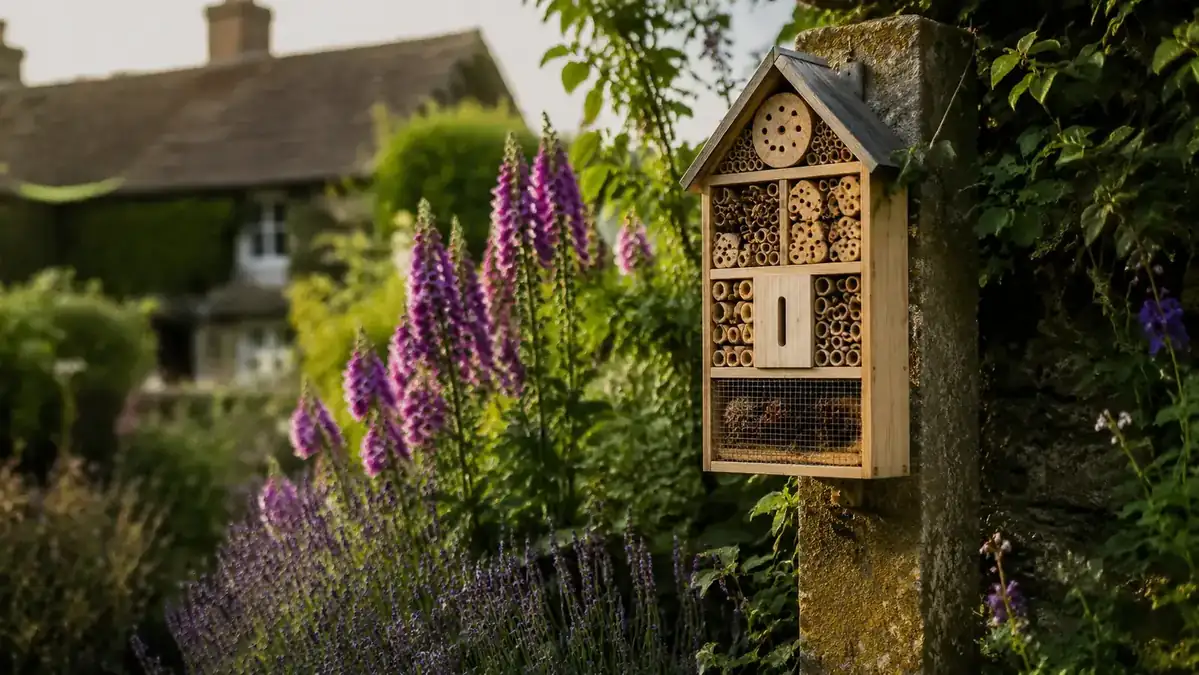
I bought my first insect hotel in the spring of the year my granddaughter asked me why there were fewer bees in my garden than there had been when she was small. That question stayed with me. I hung the Niteangel Natural Wooden Insect Hotel on the north-facing side of my potting shed, congratulated myself on doing something kind for wildlife, and then more or less forgot about it for four months. In September I went to look. The bamboo tubes were empty. Every single one.
I had done almost everything wrong, and the Niteangel had been entirely blameless. But it took me another two seasons, a lot of reading, and an uncomfortable amount of peering at tubes with a magnifying glass to understand what was actually happening inside that little wooden house. This review is about what I learned. It is not the sort of review that lists the dimensions and calls the colour 'natural.' It is the review I wish someone had left on Amazon before I ordered mine.
The Quick Verdict
A genuinely well-made insect hotel that works beautifully when sited correctly and maintained properly. Most gardeners who are disappointed with theirs have made the same siting mistakes I did. The bamboo tube situation is real and needs managing from year two onward, but it is not a reason to avoid this product.
Amazon Check Today's Price →Your pollinators are struggling. This is one of the simplest things you can do about it.
The Niteangel insect hotel is solidly made, uses real bamboo and untreated wood, and is sized generously enough to attract a range of solitary bee and beneficial insect species. If you site it correctly and follow the maintenance advice in this review, it will do genuine good in your garden.
Amazon Check Today's Price on Amazon →What Nobody Tells You About Where to Hang It
The single most important thing about an insect hotel is not the hotel. It is the placement. I say this having spent one full season getting it wrong. Solitary bees, which are the primary residents you are hoping to attract, need the tube openings to face somewhere between south-east and south-west, and they need warmth. The tubes need to heat up in the morning sun so that the developing larvae inside have the right thermal conditions. Put your insect hotel on a north-facing fence or in dappled shade and you are, in practical terms, building a very expensive bit of garden sculpture.
When I moved mine in early spring of my second season, from the north side of the potting shed to a south-facing position on my garden wall at roughly eye height, the results were so different it was almost comical. Within three weeks I had red mason bees, Osmia bicornis if you want the Latin, actively inspecting and beginning to cap tubes with mud. By midsummer, fourteen tubes in the bamboo section were sealed. Before, after an entire season in the wrong position, I had nothing.
The height matters too. Anywhere between a metre and a half and two metres is the general recommendation, but the specific detail that made a difference for me was making sure nothing was growing directly in front of the entrance. Bees approach their nesting holes on a slightly downward flight path. A large leaf or a stray stem of fennel right in front of the opening is enough to put them off. I planted lavender and catmint about sixty centimetres below and to the side, which provides foraging material close to home without blocking access.
What Actually Moves In, and What Steadfastly Does Not
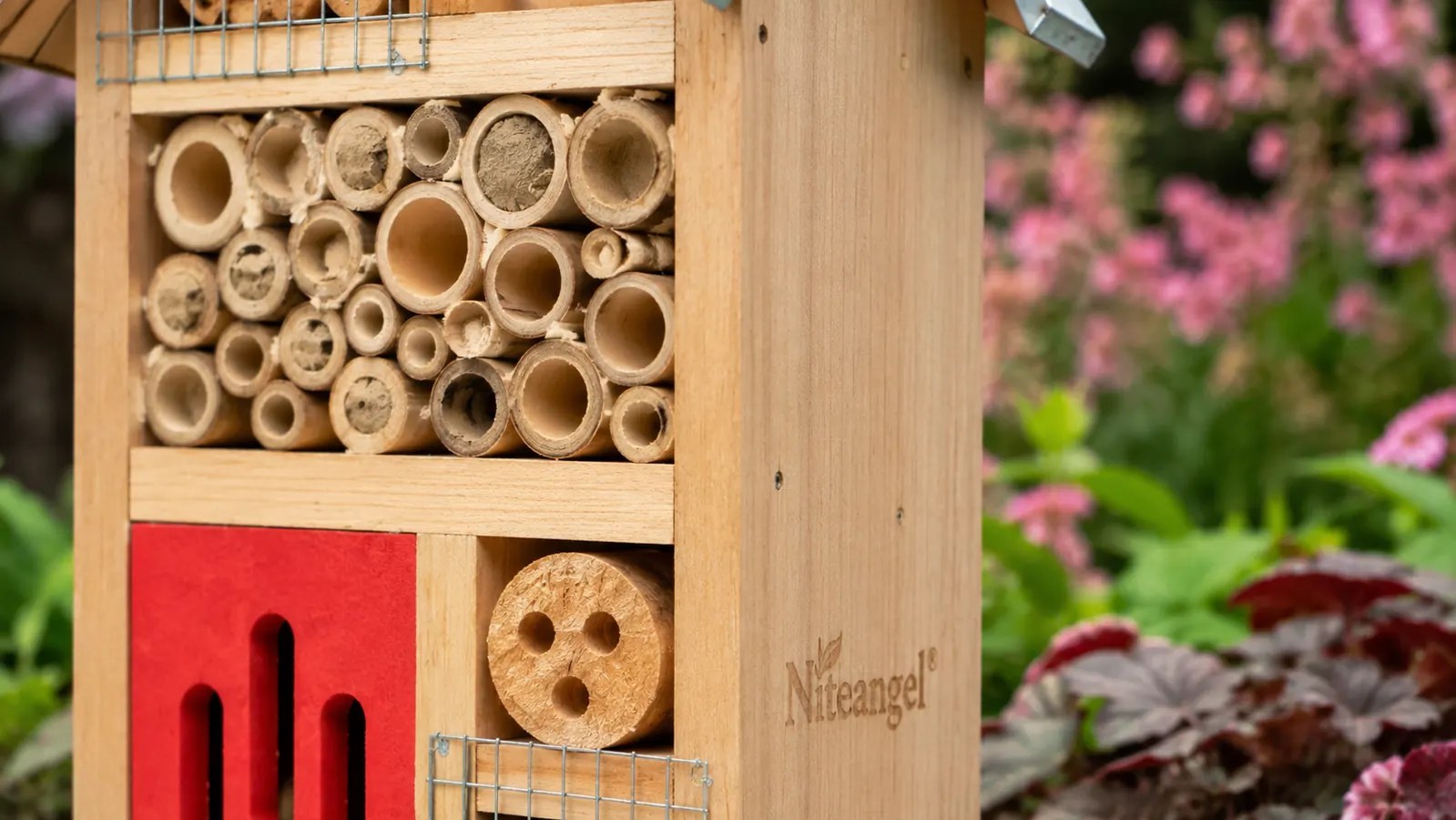
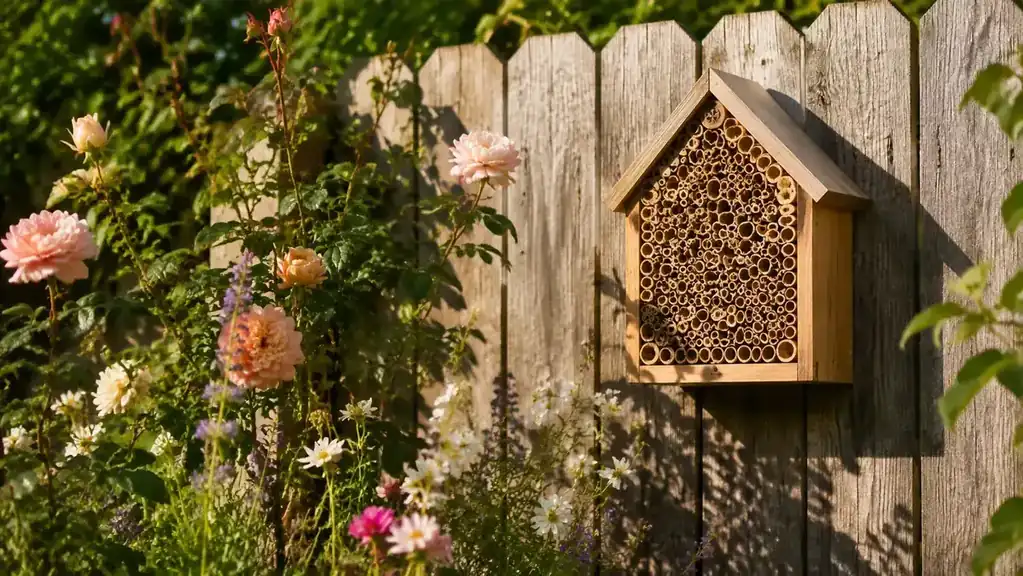
The Niteangel has seven distinct chambers: bamboo tubes, pinecones, a drilled timber block, a section of rolled corrugated cardboard, a bundle of hollow stems, a cork section, and a space filled with small twigs. This variety is genuinely useful because different invertebrates use different materials. In three seasons, here is my honest census of what moved into mine.
The bamboo tubes were by far the most popular, used consistently by red mason bees and, in the section with smaller-diameter tubes, by the very pretty leafcutter bees, Megachile species, who cap their cells with neatly cut circles of leaf rather than mud. The drilled timber block attracted one or two mason bee nests and, delightfully, a pair of earwigs who used it as a winter roost. The hollow stems had one season of what I believe was a small solitary wasp, though I did not see her in person. The corrugated cardboard? Three seasons. Nothing. The cork section? Nothing. The pinecones I cannot confidently attribute to anything beyond general invertebrate shelter.
I mention this not to criticise the design, which is common to nearly all commercial insect hotels, but to manage expectations. You are unlikely to attract ladybirds to the pinecones or lacewings to the cork unless you are extremely lucky with your garden's existing populations. The product markets itself for ladybugs, lacewings, and butterflies as well as bees. In my experience, the bees show up. The rest require specific conditions and a good deal of patience, or sometimes simply do not come. That is honest wildlife gardening, not a failure of the product.
After three seasons I can tell you plainly: the bamboo tubes work, the drilled block works, and the hollow stems sometimes work. Everything else is habitat provision with no guarantee of tenancy.
The Bamboo Tube Problem Nobody Mentions in Five-Star Reviews
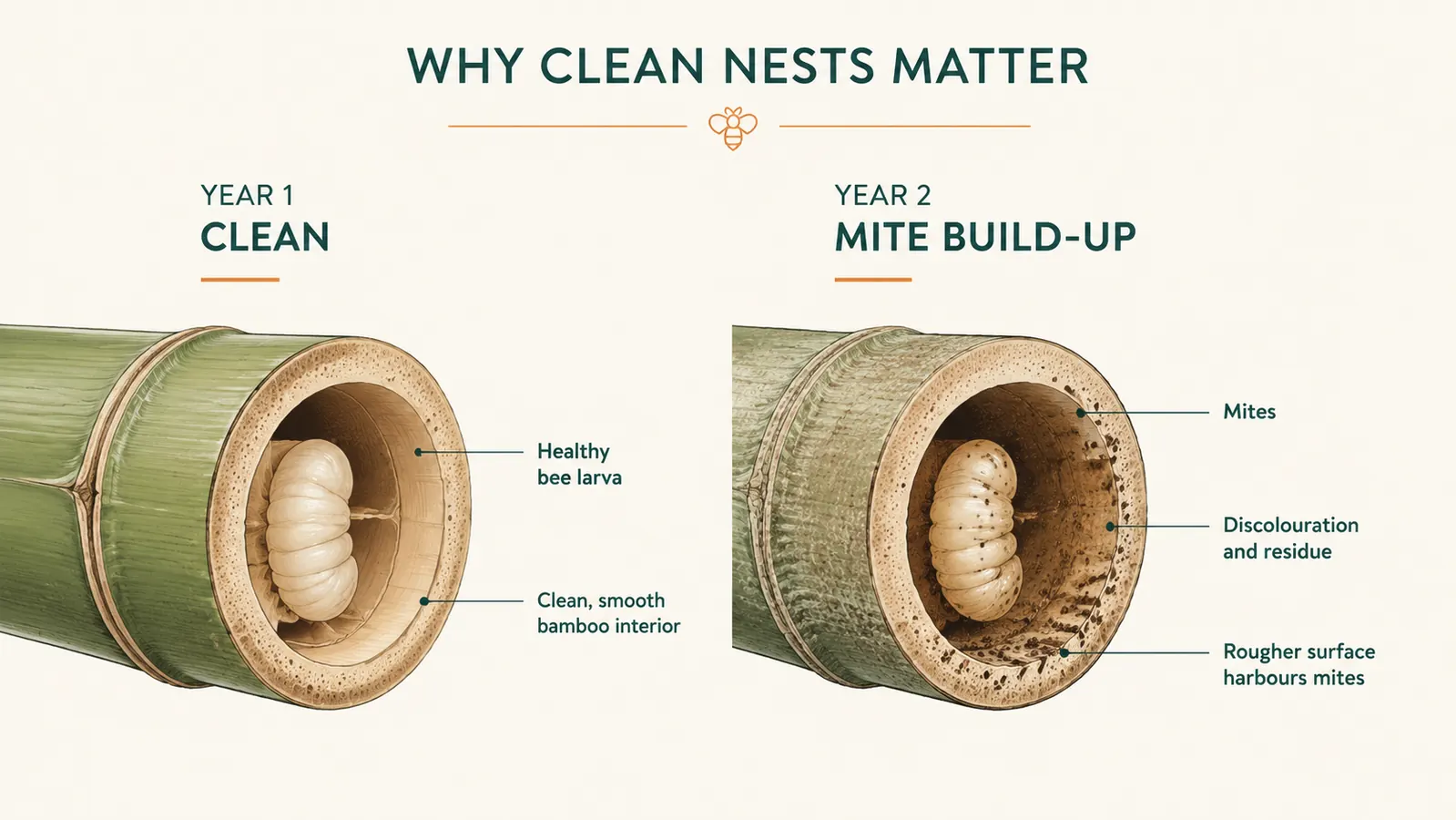
Here is the part of insect hotel ownership that the cheerful reviews tend to leave out. Bamboo tubes, when used as nesting sites by solitary bees, accumulate parasites. Specifically, a mite called Chaetodactylus osmiae has evolved to hitchhike into the cells of red mason bees, where it feeds on the pollen stores the mother bee has collected for her larvae. In a healthy natural setting, with predators present and nests dispersed across a landscape, this is a manageable problem. In a small wooden box on your garden fence, it is not.
By the end of my second season, when I opened one of the bamboo sections for inspection, several tubes were heavily infested. The mite bodies are tiny and orange-red, and they cluster at the entrance to sealed cells. A badly infested tube will not just lose one season's larvae, it will seed the adjacent tubes the following spring when adult bees emerge and brush against the mite colonies on their way out. I lost perhaps a third of the cells in that section to confirmed mite damage. A further unknown proportion may have failed for the same reason without my being able to tell.
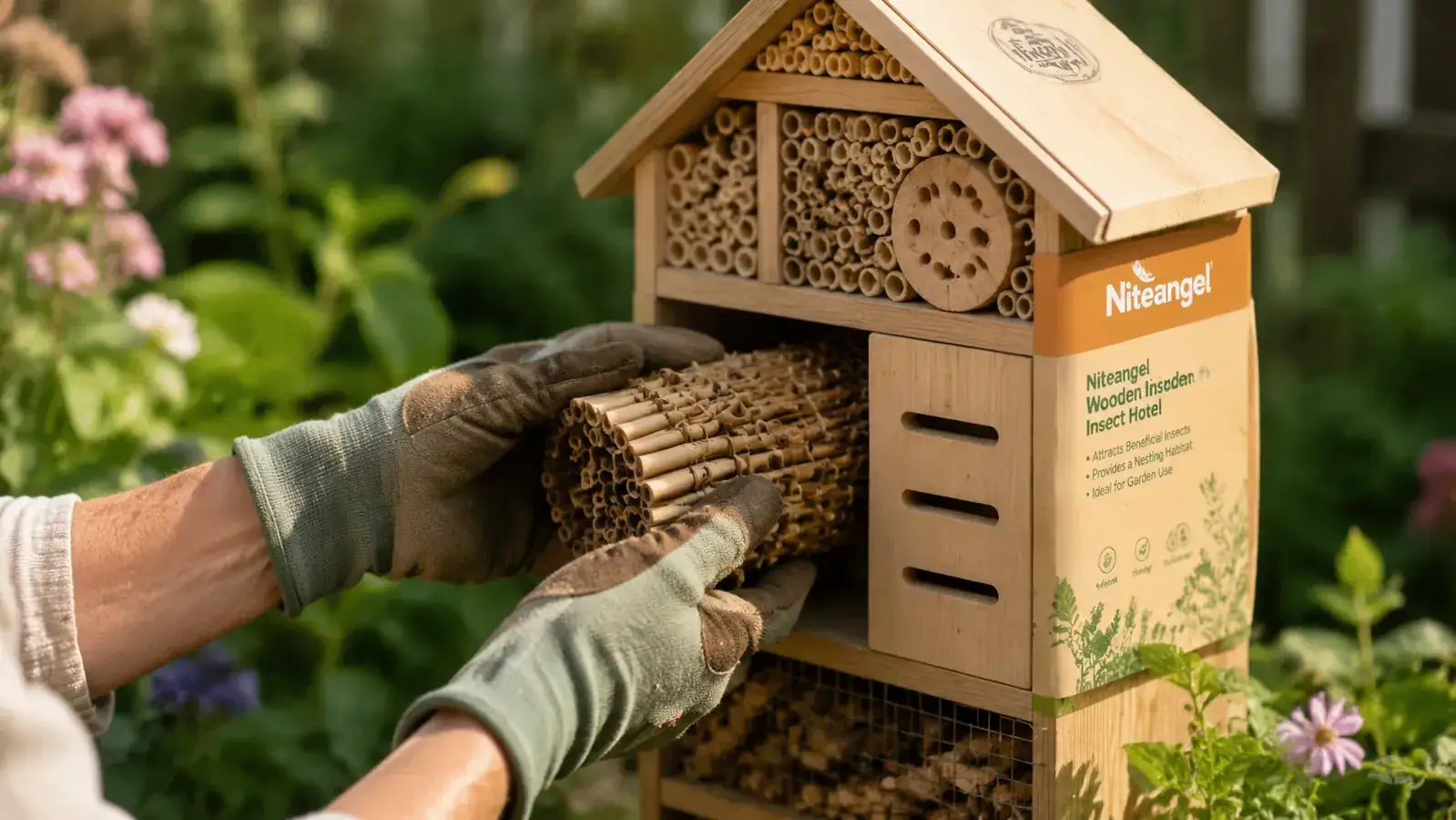
The solution is not to stop using bamboo tubes. It is to treat them as a consumable rather than a permanent fixture. Wildlife gardening organisations, the RSPB among them, now recommend replacing bamboo tube inserts after two seasons at most. Some say one. This is not a flaw specific to the Niteangel. It is a reality of any bamboo-tube insect hotel. The Niteangel has the modest advantage of coming with replaceable inserts rather than tubes glued permanently in place, which means you can swap them out without replacing the whole hotel. I now buy a spare set of bamboo inserts each autumn, let the occupied tubes overwinter undisturbed until the following May or June when adults have emerged, then retire the old inserts and install new ones.
When to Retire a Chamber, and How to Do It Without Losing the Season's Larvae
This is the practical question that took me most of that second autumn to work out, and I made at least one significant mistake in the process. My instinct, on discovering the mite infestation in September, was to remove the affected tubes immediately. I did not. The larvae developing inside sealed cells were still alive, still overwintering, and would emerge as adults the following spring. Removing the tubes in autumn would have meant discarding them, and the living creatures inside.
The correct approach, as I understand it now, is this. Leave occupied tubes completely undisturbed from the time they are sealed in summer through to late May or June of the following year, by which point the adults will have emerged. After emergence, you can remove and dispose of the old bamboo inserts. I store my retired tubes in a paper bag in the shed for one more season as a precaution, in case any late-emerging species are still inside, then compost them the autumn after that. New inserts go in while the old ones are still overwintering, placed in a separate section of the hotel or a separate structure altogether.
I also now do a brief visual inspection each July, using a small torch to look into any tubes that appear sealed but not freshly capped. Mite-infested cells sometimes have a distinctive orange tinge at the entrance. A tube that is heavily infected and in which I cannot identify a live cell is gently removed and replaced mid-season. It is not a perfect system, but it has reduced my apparent mite losses significantly.
Build Quality and What Three English Winters Did to Mine
The Niteangel is made from real timber and real bamboo. It is not the sort of thing held together with a staple gun and hope. In three years exposed to a fairly wet English-style winter, the roof has not split, the frame has not warped to the point of distortion, and the bamboo tubes, while they have darkened, have not collapsed or become dangerously porous. The timber does grey and weather, which I find rather pleasing. It looks as though it belongs in a garden rather than having arrived from a factory yesterday.
One genuine practical note: the hanging hardware is minimal. The hotel ships with a basic wire loop on the back. It is adequate, but after my second winter I replaced it with a sturdier hook, partly because the wire had bent slightly and partly because I wanted to be more certain about the angle. An insect hotel should hang level or with a very slight forward tilt, perhaps five degrees, so that rainwater does not sit in the tube openings. The original wire makes this alignment a little harder to achieve than it ought to be. A five-minute job with a drill and a proper picture hook solved it entirely.
What I Liked
- Genuinely well-constructed from real timber and bamboo, not pressed board
- Replaceable bamboo inserts make proper seasonal maintenance possible
- Multiple chamber types give a range of invertebrate species something to use
- Weathers gracefully and looks at home in a cottage or wildlife garden
- Sized generously enough that mason bees, leafcutters, and other solitary species can use it simultaneously
- Tubes sealed and occupied by year two once properly sited, in my experience
Where It Falls Short
- Bamboo tubes must be replaced every one to two seasons due to mite accumulation, ongoing cost to factor in
- Hanging hardware is the weakest part of an otherwise solid product
- Several chamber types, particularly cork and cardboard sections, have attracted nothing in three seasons of use
- Marketing claims about butterflies and lacewings are aspirational rather than consistently achievable
Who This Is For
This hotel suits the gardener who genuinely wants to support pollinators and is willing to do a small amount of seasonal maintenance to make that happen. If you will commit to correct placement from the start, south-facing and in full sun, and if you will replace bamboo inserts every two seasons and leave occupied tubes undisturbed through winter, the Niteangel will earn its place in your garden. The quality of construction means it is a ten-year proposition rather than a one-summer decoration. Over that span, the cost per season becomes quite modest, even allowing for replacement inserts.
Who Should Skip It
If you want something you can hang in a shaded corner, ignore completely, and still expect results, this will disappoint you, as any insect hotel would. If your garden has no south-facing aspect and no sheltered sunny wall or fence, solitary bees are likely to find better nesting sites elsewhere regardless of what you provide. And if you are hoping primarily for butterflies or lacewings rather than solitary bees, you will almost certainly be disappointed, because those species do not typically use the features in this kind of hotel in the numbers the marketing photographs suggest. For true butterfly support, the more effective intervention is planting: nettles for red admirals and peacocks, buckthorn for brimstones, and so on.
Ready to give solitary bees an actual home, not just a decorative box?
The Niteangel insect hotel has worked well for me across three seasons once I stopped making the mistakes described above. Solid timber, real bamboo, replaceable inserts. It is one of the better-built options at this price, and the wildlife in my garden is noticeably better for it.
Amazon Check Today's Price on Amazon →