
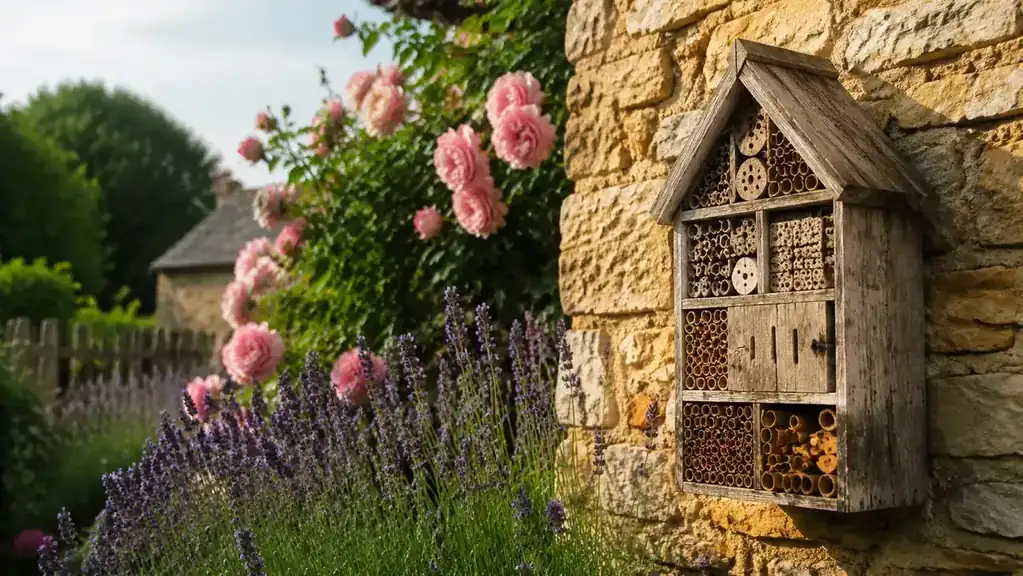
The bamboo tubes were sealed by mid-May. That was the moment I knew the Niteangel insect hotel was actually working. I had been watching the thing for six weeks, half-convinced I had mounted a rather expensive piece of garden ornament on my fence. Then one morning, cup of tea in hand, I stood at the kitchen window and counted eleven mud plugs where there had been none the evening before. Red mason bees, Osmia bicornis, had been quietly working through the night.
I have kept a cottage garden in Devon for thirty-one years. Over that time I have tried three bamboo-tube arrangements fixed together with rubber bands, two painted wooden bee boxes from garden centres, and one rather ambitious homemade construction involving a wooden pallet and a staple gun. All of them either fell apart within a season, never attracted a single insect, or both. When I ordered the Niteangel Natural Wooden Insect Hotel in February of last year, I expected more of the same. I was wrong, though not entirely.
The Quick Verdict
The best-built insect hotel I have owned at this price. The bamboo tubes attract mason bees reliably, the lacewing chamber works from autumn onward, and the wood holds up through a wet Devon winter. The pine cone and bark sections attracted less than I had hoped, and the hanging hardware needs replacing in year two. Worth every penny if you position it correctly.
Amazon Check Today's Price →Your cottage garden is already missing its best pollinators. Here is how to invite them back.
The Niteangel insect hotel has 1,877 reviews and a 4.5-star rating on Amazon. Check the current price before it changes.
Amazon Check Today's Price on Amazon →How I Have Used It: Installation and the First Season
I fixed the hotel to the south-facing fence panel in my cutting garden on the 4th of March, at a height of roughly 1.2 metres, which is where my eye line falls naturally when I am deadheading. The south-facing aspect was deliberate. Solitary bees need warmth to get going in the morning, and a south or south-east wall gives them the early sun that prompts them to fly. If I had mounted it in a shady spot, I suspect the bamboo chambers would still be empty.
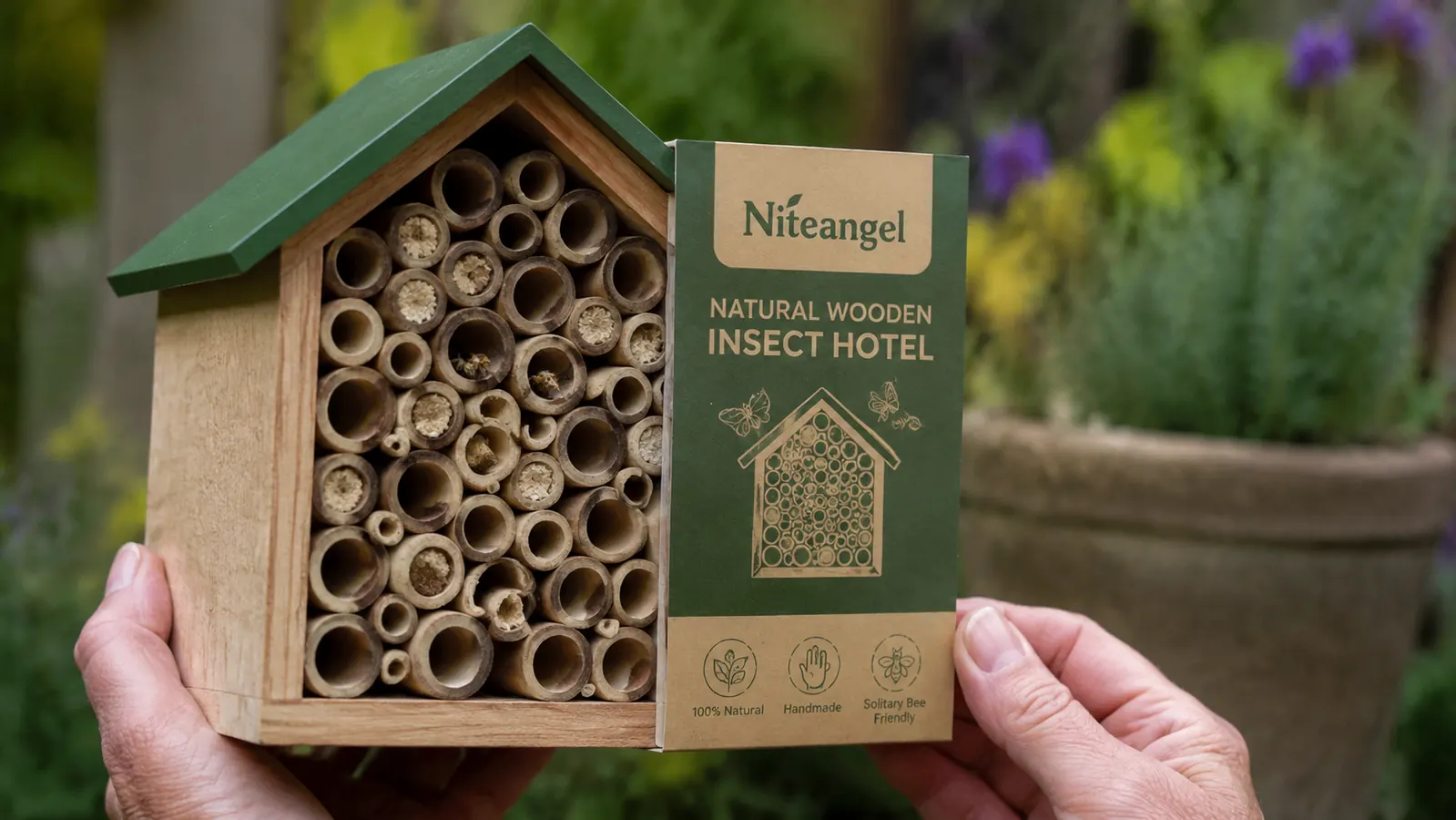
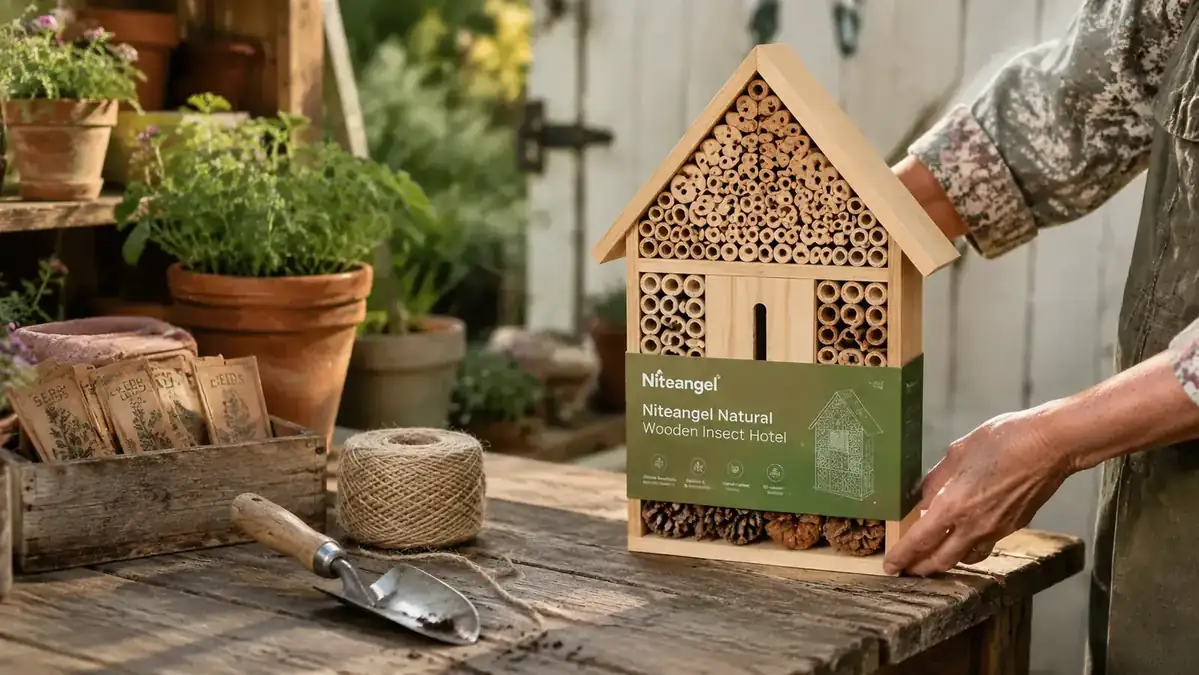
The hotel arrived in good condition with clear instructions. Assembly took about twenty minutes. The frame is FSC-certified pine, and it feels noticeably more solid than anything I have bought in a garden centre. The chambers include drilled pine blocks, bundled bamboo tubes in two diameters, a section of pine cones and bark chips, a mesh cage filled with rolled corrugated cardboard for lacewings, and a woven straw bundle. The variety matters, because different insects need different aperture sizes and materials.
By the end of the first week of April, mason bees had begun prospecting the 6mm bamboo tubes. By mid-May, as I mentioned, eleven tubes were sealed. By June, a total of nineteen tubes had been provisioned and closed. I also found a small colony of leafcutter bees, Megachile species, in the larger-diameter drilled wood blocks during July, which I identified by the perfectly circular leaf cuts they carry in to line their cells.
What the Bamboo Tubes Do (and Do Not) Attract
The bamboo section is the star of this hotel, and I say that having watched it closely through the season. Red mason bees are the primary tenants, but I also recorded blue mason bees in the narrower tubes, and two species I could not confidently identify without a hand lens. The key is the diameter. The 6mm tubes suit Osmia bicornis particularly well. The slightly wider tubes attracted different species. Having a mix of sizes in a single structure means you are catering for more than one bee, which is the whole point.
What the tubes do not attract, at least in my garden, is honey bees. I mention this because I sometimes hear people say they want to help honey bees by buying an insect hotel. Honey bees nest in cavities large enough for a colony of thousands. A bamboo tube holds one female and her egg cells. If you want to support honey bees, plant forage flowers. If you want to support solitary bees, which are in many cases more efficient pollinators than honey bees, this hotel does that job well.
By the end of May, nineteen bamboo tubes had been sealed. That is nineteen solitary bee nests in a garden that had none the year before. You can feel that in the number of squash flowers that set fruit.
The Lacewing Chamber, the Pine Cones, and What Happened in Autumn
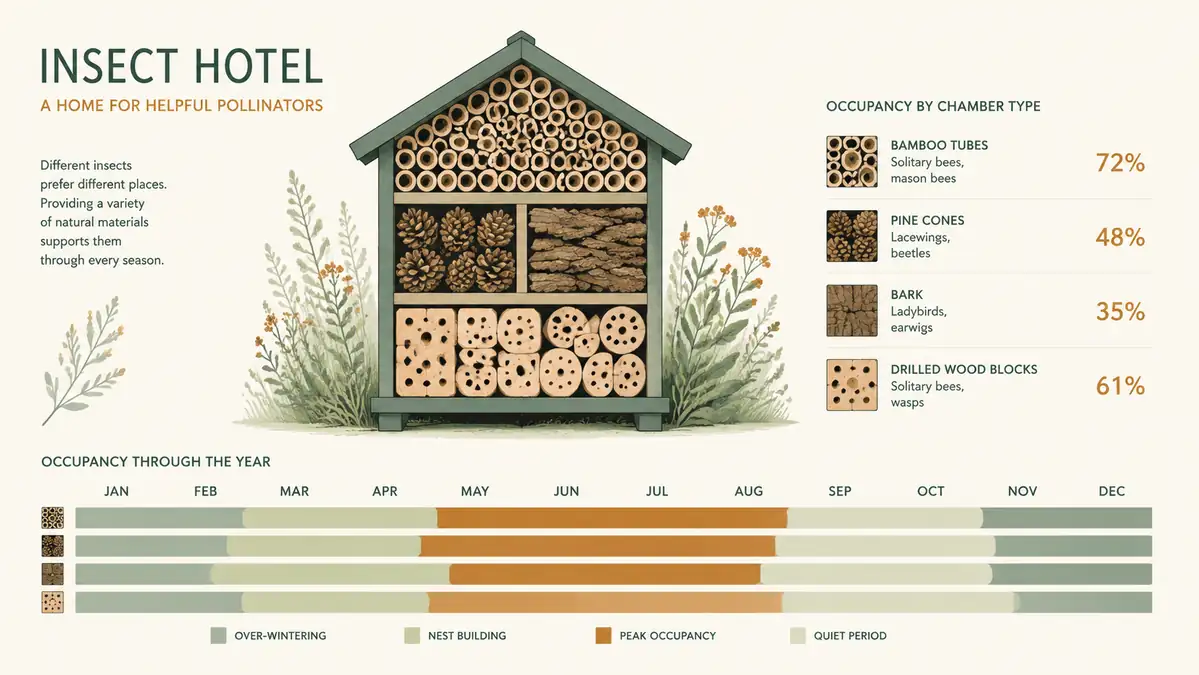
The corrugated cardboard lacewing chamber sat empty through the spring and summer, which I had expected. Lacewings overwinter as adults and lay eggs in summer on long silk stalks above aphid colonies. By October, the cardboard chamber was occupied by a small cluster of common green lacewings, Chrysoperla carnea, which had turned the amber-brown colour they adopt for winter. I was pleased to see them. A lacewing larva eats its own body weight in aphids each day, which makes one overwintering lacewing worth more to my roses than any spray I could buy.
The pine cone and bark chip sections were the disappointment. I found a single harvestman using the bark section in October, and nothing at all in the pine cones over the full twelve months. I suspect the pine cones dry out too quickly and do not hold the humidity that would attract beetles or earwigs. A handful of damp moss tucked alongside the pine cones might help, though I have not tried that yet. Earwigs in particular are excellent garden predators and I would love to encourage them, but this section of the hotel has not managed it so far.
Build Quality After One Year: Wood, Hardware, and the Devon Weather
We had an unusually wet October and November last year. The kind of rain that comes sideways and turns the lane to a stream. The Niteangel hotel sat on its fence panel through all of it, and the wood held up better than I had expected. There was some surface greying on the roof and the top frame, which is the natural weathering of untreated pine, not rot. The floor of the hotel remained dry enough inside to run my finger along without picking up dampness. The joinery is tight. Nothing shifted or swelled shut.
The hanging hardware is the one area where I would have done things differently from the start. The hotel comes with two small screw hooks for hanging, and they are adequate for a sheltered garden. Mine is not a sheltered garden. By February, one hook had pulled slightly from the wood after a particularly determined gale, and I replaced both hooks with longer, heavier-gauge screws. If your garden catches the wind, do the same before you hang it rather than after. It is a five-minute job, and it will save you anxiety.
The bamboo tubes themselves have held together well. I had worried that the ends might split or the tubes crack in frost, because I have seen that happen with cheaper bundles. None of the Niteangel tubes split over winter, and the mud plugs the bees laid remained intact into spring, which means the egg cells inside were protected as intended.
How It Changed What I See in the Garden
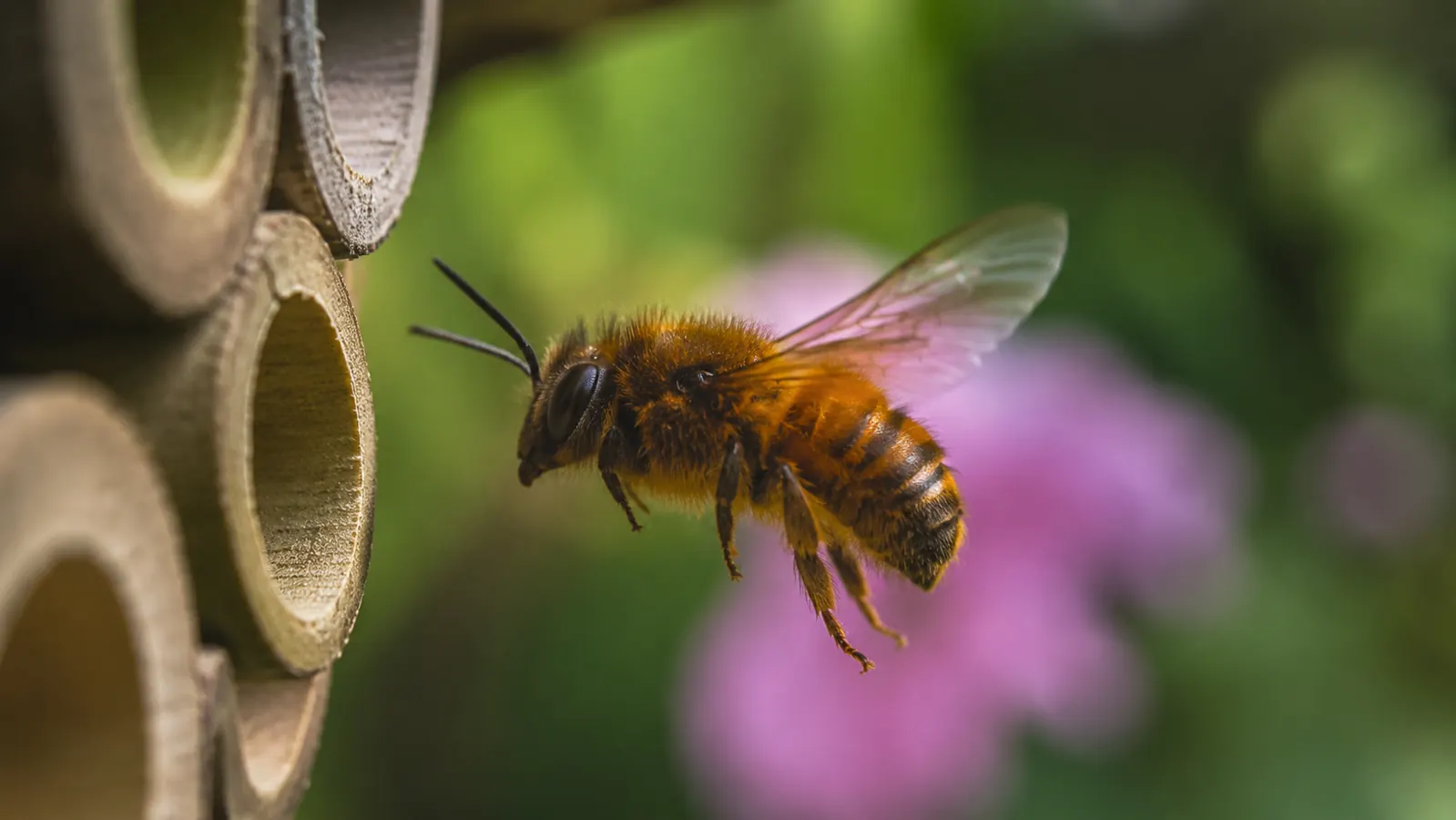
I want to say something about the less measurable side of this, because I think it matters. Before I installed the hotel, I would see the occasional solitary bee working the hardy geraniums or the alliums. Occasional. After the hotel was established and the mason bees had a nesting site to return to, the bee activity in the kitchen garden became a consistent background presence. There was almost always something foraging within three or four metres of the hotel during the main season. My courgettes set more fruit than they have in the last six years. My runner beans did not need hand-pollinating once.
I also noticed a pair of great tits investigating the hotel in March of this year, before the mason bees arrived. They were not nesting, they were hunting for overwintering invertebrates in the bark and pine cone sections. That is not damage, that is the food web working. A wildlife garden is not a zoo. Things eat other things. The presence of insect life at multiple stages of the year is what brings in the birds, and the presence of birds is part of what makes sitting in the garden worthwhile.
Niteangel vs the Cheaper Options: What the Price Difference Buys You
I have tried the garden centre alternatives, so let me be direct. The mass-produced insect hotels you find for under ten dollars in general retailers are mostly decorative. The bamboo tubes are too short for mason bees to complete a full nest, the wood is stapled rather than properly jointed, and most of them fall apart by autumn. I have thrown three away. The Niteangel sits above that category. The tubes are the correct length, the construction is solid, and the variety of chambers is genuinely functional rather than merely aesthetic.
Compared to a purpose-built mason bee house at twice the price, the Niteangel makes sense if you want to support a range of insects rather than one species. A dedicated mason bee house with replaceable liners is arguably better for the bees themselves, because you can clean and replace the tubes annually to prevent parasite build-up. The Niteangel cannot be cleaned in the same way. After a full year I am replacing the bamboo bundle entirely as a precaution, which adds a small ongoing cost. That is not a reason not to buy it. It is simply something to be aware of.
What I Liked
- Bamboo tubes attracted red mason bees reliably from the first spring season
- Solid FSC pine construction held through a wet West Country winter without warping or splitting
- Multiple chamber types support different insect species across the full year, including overwintering lacewings
- Correct tube lengths for mason bee nesting, unlike cheaper alternatives
- Straightforward assembly, about twenty minutes, with clear instructions included
- Noticeable increase in pollinator activity and fruiting across the kitchen garden within one season
Where It Falls Short
- Pine cone and bark sections attracted almost nothing in my first year of use
- Hanging hardware is lightweight and needs upgrading with heavier screws in exposed gardens
- Bamboo tubes should be replaced annually to reduce parasite risk, adding a small recurring cost
- Does not attract honey bees, which surprises buyers who expect otherwise
- Surface weathering is natural but may not suit gardeners who prefer a tidy appearance year-round
Who This Is For
This hotel suits the gardener who genuinely wants to support pollinators and understands that wildlife gardening requires a little patience. If you plant nectar-rich flowers, have a south or east-facing fence or wall to mount it on, and can give it one or two seasons to establish as a known nesting site, the Niteangel will reward you with visible, measurable results. It is also a very fine thing to explain to grandchildren. Standing at the fence in May and pointing out a bee sealing its nest is the kind of thing that sticks in a child's memory.
Who Should Skip It
If your garden is entirely north-facing, densely shaded, or paved with minimal planting, the hotel may sit empty. Solitary bees need warmth and foraging flowers within flying range, roughly 300 metres. If those conditions are absent, the most beautifully built insect hotel in the world will not help you. Similarly, if you expect immediate results within the first few weeks of hanging it, you may be disappointed. Wildlife finds new habitat gradually. The first year is often quieter than the second.
If your garden already has flowers and a sunny wall, this is the simplest thing you can do for your local bees.
The Niteangel insect hotel has a 4.5-star rating from over 1,877 gardeners on Amazon. It ships quickly and arrives ready to assemble in about twenty minutes. Check the current price below.
Amazon Check Today's Price on Amazon →