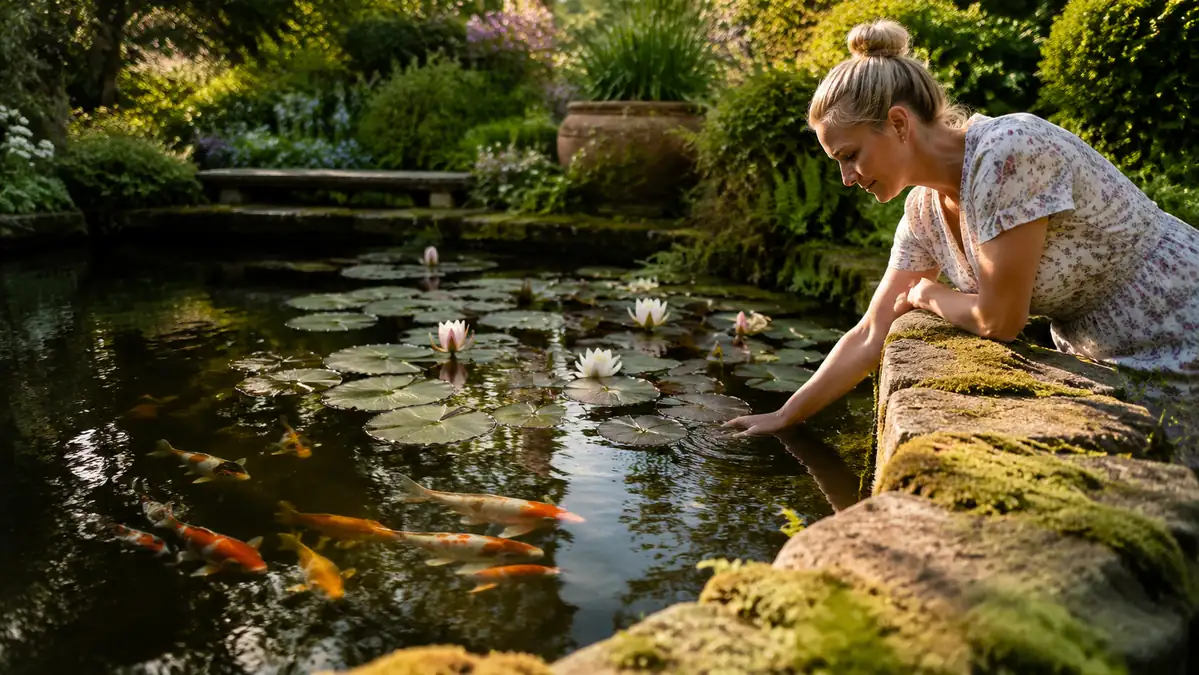
This is a season-by-season guide to feeding koi properly, written by a thirty-year keeper. The food I keep coming back to for the active months is CrystalClear Staple Pond Fish Food, and you will see why as we walk through each season. If you have been keeping koi for any length of time, you will know the anxiety that comes with the turn of the seasons. Spring arrives and you wonder whether it is too soon to start feeding again. Summer gets away from you and you worry you have been overfeeding in the heat. Then autumn creeps in, the water cools, and nobody seems to agree on exactly when to stop. I have kept koi in my cottage garden pond for over thirty years, and the single most common mistake I see new koi keepers make is treating feeding as a year-round constant rather than a seasonal rhythm that changes with the water temperature. The wrong approach does not just waste food. It can kill fish.
The good news is that once you understand the reason behind each seasonal adjustment, the whole thing becomes quite logical. Koi are cold-blooded. Their digestion slows as the water cools and speeds up as it warms. Feed too much in cold water and the food sits in their gut, rotting rather than digesting, making them seriously ill. Feed too little in summer and you miss the main growth window of the year. This guide walks you through each season in turn, with specific temperature thresholds and the food type I reach for at every stage. I use CrystalClear Staple Pond Fish Food for most of the active feeding season. It is a floating pellet, which matters more than most people realise, and I will explain exactly why as we go.
Worried you are feeding your koi at the wrong time of year? Start here.
CrystalClear Staple floating pellets are formulated for easy digestion during the active feeding season, with a protein level that supports healthy growth without clouding your water. Used by koi keepers who want to see their fish thrive from April through October.
Amazon Check Today's Price on Amazon →Why Water Temperature Is the Only Number That Actually Matters
Before we get into the steps, let me make one thing very clear: forget the calendar. The date on which you start or stop feeding your koi should be determined entirely by water temperature, not by what month it is. A mild February can have pond water sitting at 55 degrees Fahrenheit. A cold snap in late April can drop it back below 50. The fish do not know what month it is, but their digestive system responds directly to the water around them.
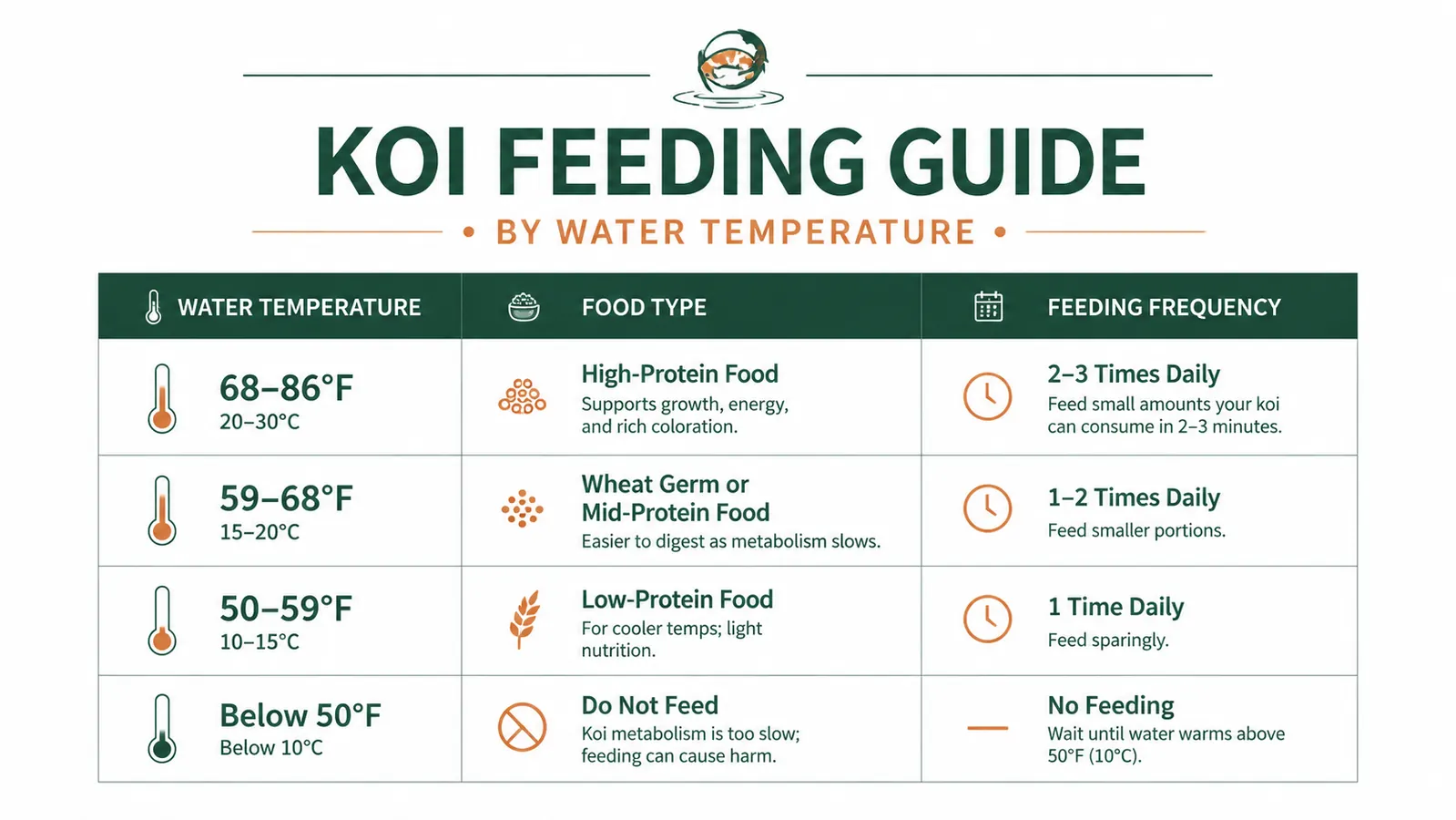
A floating pond thermometer is one of the most useful things you can keep beside the pond. I check mine every morning from February through November. The key thresholds are straightforward: below 50 degrees Fahrenheit, do not feed at all. Between 50 and 59 degrees, feed a wheat germ-based food once daily at most, and only if the fish are actively moving. Between 60 and 85 degrees, you are in the main feeding season and CrystalClear Staple pellets are what I reach for. Above 85 degrees you need to cut back sharply again, because koi oxygen demand rises dramatically in very warm water. I will walk through each of these ranges as separate seasonal steps.
Step 1 (Late Winter to Early Spring): Wake Up Your Pond Before You Feed
Water temperature: below 50 degrees Fahrenheit. Do not feed. I know this can feel difficult when you walk out on a mild February morning and your koi are moving near the surface, tilting their heads at you hopefully. They have learned that you appear at the pond edge with food. But those movements are not hunger. They are reflex. A koi's digestive system is essentially dormant below 50 degrees, and anything you put in will not be processed. It will decay inside the fish. This is one of the most reliable ways to trigger a serious infection or even lose a fish before spring properly arrives.
What you should be doing during this period is attending to your filtration. Run your pump and filter through winter at a reduced rate if your pond is deep enough not to freeze. If you switched off the pump for the coldest months, now is the time to restart it gently, check for debris that has accumulated under the ice, and do a partial water change with properly dechlorinated tap water. Your pond should be clean and oxygenated before you put a single pellet in. The fish are better served by good water quality right now than by food.
Keep monitoring your thermometer daily. The moment it consistently reads above 50 degrees for several days in a row, you can begin the transition. One mild afternoon is not enough. Wait for a genuine pattern.
Step 2 (Spring Transition): Wheat Germ Food, Small Amounts, Once Daily
Water temperature: 50 to 59 degrees Fahrenheit. This is the trickiest period because the fish look hungry and the weather is brightening. Feed a wheat germ-based food only during this transition phase. Wheat germ is easier to digest in cooler water because it contains lower protein levels than standard staple pellets. You can find wheat germ koi food from most pond suppliers. Feed once per day at most, a very small pinch, only if the fish are actively swimming and coming to the surface. If they ignore the food after two or three minutes, remove it immediately with a net. Uneaten food pollutes your water fast.
I find the easiest way to judge the right quantity at this time of year is the five-minute rule: put a small amount in and watch carefully. Everything the fish eat within five minutes is the right amount. Anything left after five minutes is too much. This rule actually applies year-round, but it is most important in spring when overfeeding has the fastest consequences. Your pond water is still cool, biological filtration bacteria are waking up slowly, and the pond's capacity to break down waste is at its annual low.
Step 3 (Late Spring Through Summer): The Main Growing Season
Water temperature: 60 to 85 degrees Fahrenheit. This is when koi genuinely need to eat well, and when feeding correctly pays off in visible growth, vivid colour, and fish that behave actively and confidently. I switch to CrystalClear Staple floating pellets at this point. I have used several brands over the years and keep coming back to these because they are formulated for easy digestion, the pellets float consistently, and they do not cloud the water the way some cheaper options do. You can read more detail in my full review of these pellets at the crystalclear-staple-fish-food-review-long-term page, but the short answer is that they do what they say.
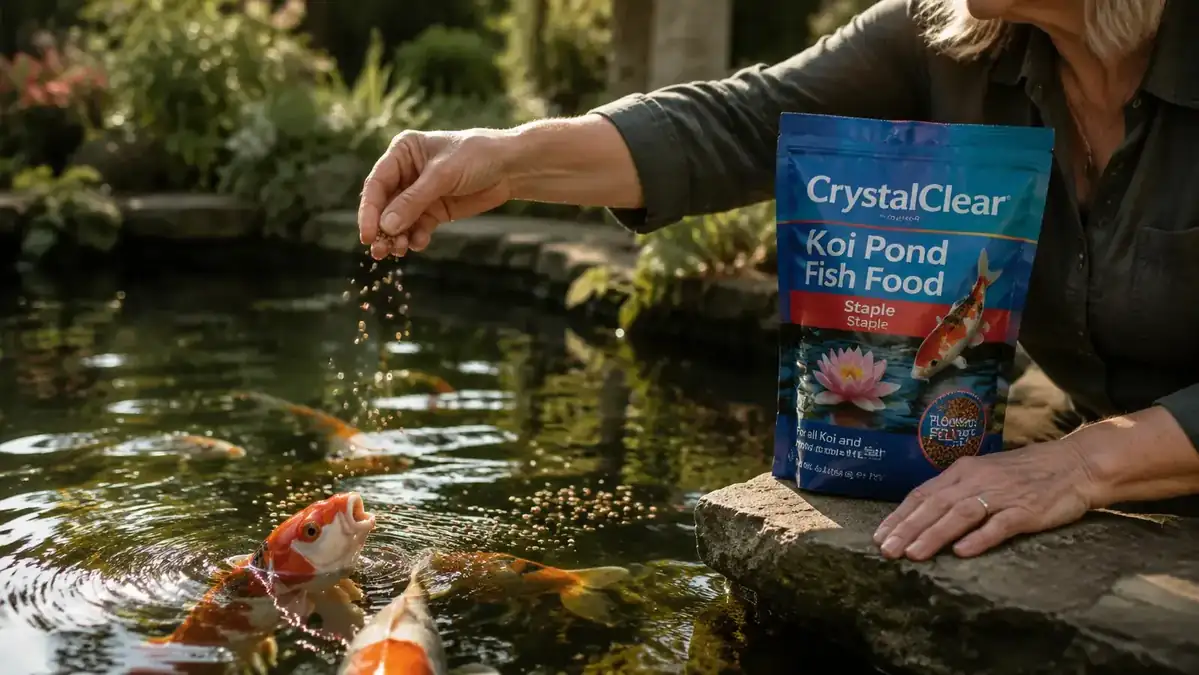
Feed two to four times daily during peak summer, always using the five-minute rule. The exact number of feedings depends on how warm your water is and how many fish you have. A heavily stocked pond in 80-degree water can handle three feedings comfortably. A lightly stocked pond with mature filtration can manage four. The floating pellet format matters here because you can see exactly what has been eaten and what has not. Sunken food is invisible and becomes toxic ammonia in your pond. With floating pellets, uneaten food is obvious and easy to remove before it causes problems.
This is also the period when colour-enhancing foods are sometimes recommended. I use them for a few weeks in midsummer when the koi are at peak health, but I would not give up a quality staple food in favour of a colour food for the whole season. Colour pigments are a nice bonus. Good nutrition across the whole body is the priority. If you want to understand more about why floating pellets beat other formats at any time of year, the 10-reasons-floating-koi-pellets-beat-flakes article covers the main arguments in detail.
Step 4 (Autumn): Slowing Down Gradually as Temperatures Drop
Water temperature: dropping from 65 toward 50 degrees Fahrenheit. Most koi keepers underestimate how quickly this change should happen. As soon as your pond temperature reliably drops below 65 degrees in late summer or early autumn, begin reducing the number of feedings. Drop from three or four times a day to twice daily, then to once daily as you approach 59 degrees. Reduce the quantity at each feeding too, not just the frequency.
The mistake I see every autumn is people feeding well into October because the koi are still swimming and still looking for food. But looking for food is not the same as being able to digest it safely.
By the time the water has cooled to around 59 degrees, switch back to a wheat germ food for ease of digestion, mirroring what you did in spring. Continue cutting quantities. A small pond with a few koi can transition to once every two days at this stage. Keep the five-minute rule firmly in mind. Any food left floating after five minutes should come out immediately. In autumn, your biological filter bacteria are also slowing down, which means the water's capacity to process waste is dropping week by week. Overfeeding now is more dangerous than overfeeding in any other season.
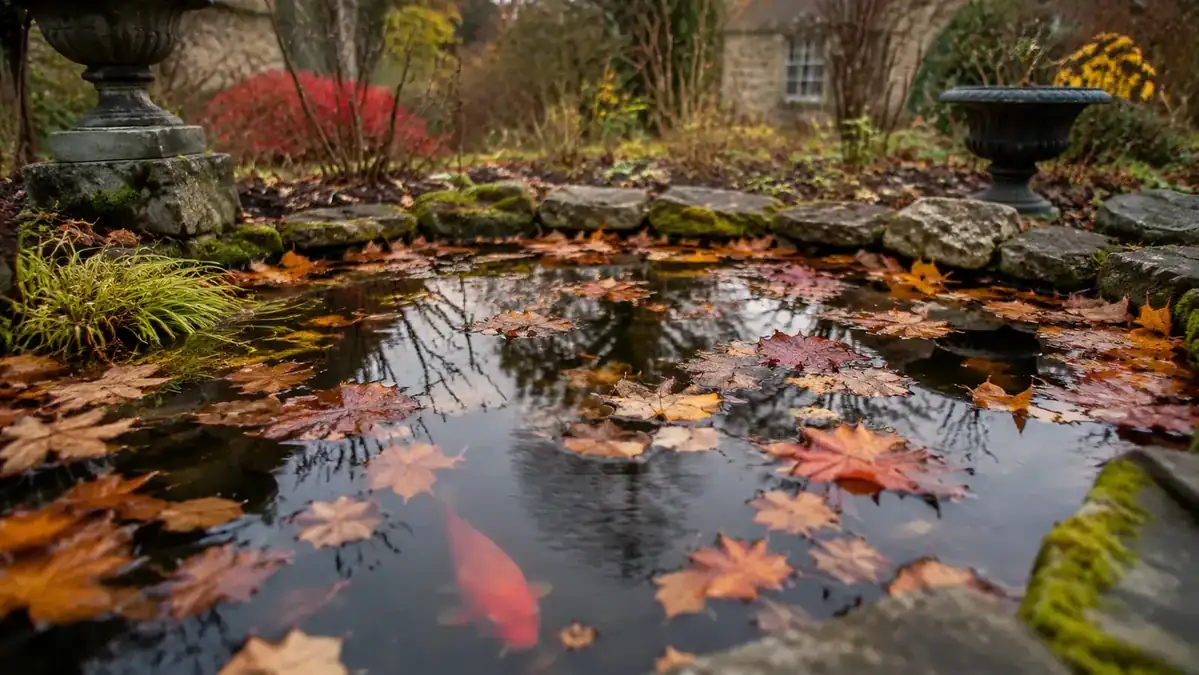
Remove any leaves that blow onto the pond surface promptly. Decomposing leaves release tannins and drive up ammonia levels in autumn ponds, exactly when your filtration is least able to cope. A simple pond net stretched over the surface through leaf-fall season is one of the best things you can do for water quality at this time of year.
Step 5 (Winter): Stop Feeding, Protect the Pond, Wait
Water temperature: consistently below 50 degrees Fahrenheit. Stop feeding entirely. This feels counterintuitive, especially for new koi keepers who feel they are neglecting their fish. But koi in water below 50 degrees have slowed their metabolism to the point where they can survive on the stored body fat they have built up through a well-fed summer. They do not need food. What they need is clean, oxygenated water and peace.
If your pond is at least three feet deep, your koi should overwinter without difficulty in most parts of the country. Keep a pond heater or de-icer running to prevent the surface from freezing completely solid. If the entire surface ices over, toxic gases produced by decomposing organic matter cannot escape and will accumulate to dangerous levels. A small area of open water is all that is needed. Do not break ice by smashing it; the shockwave causes stress. Use a pot of hot water placed on the ice surface instead to melt a hole gently.
Reduce your pump and filter to a slow circulation rather than switching them off completely, unless your winters are severe enough that the pump itself risks freezing. Ideally, lift the pump slightly off the bottom of the pond in winter so it circulates the warmer mid-level water rather than pulling the coldest water up from the floor. Your koi will be resting at the bottom, where the water is at its most stable temperature, and you want to disturb them as little as possible.
What Else Helps Koi Through Every Season
Feeding is the most variable part of koi care across the seasons, but a few constants support everything else. Water quality testing, even a simple ammonia and pH strip test done fortnightly, catches problems before they become crises. A partial water change of ten to fifteen percent every week or two keeps dissolved waste from building up, regardless of the season. Just make sure any tap water added is properly dechlorinated first. Filtration running consistently, even at low flow in winter, keeps beneficial bacteria populations alive so you are not starting from scratch each spring. These habits, combined with the right feeding rhythm, are what keep koi healthy through thirty-plus years in a garden pond.
If you are new to koi keeping and still building your confidence with feeding quantities, a floating pellet food is your best friend for the simple reason that you can always see what is happening. There is no guesswork about whether uneaten food has sunk. What floats is what is left, and what is left tells you immediately whether you have put in too much. CrystalClear Staple pellets float reliably and consistently, which is one of the practical reasons I have stayed with them through the main growing season for several years now.
Give your koi the growing season they deserve this year.
CrystalClear Staple Pond Fish Food is a high-protein floating pellet formulated for active koi during the warm months. It supports healthy growth, vivid colour, and clear pond water. Check the current price and bag sizes on Amazon before you stock up for spring.
Amazon Check Today's Price on Amazon →