
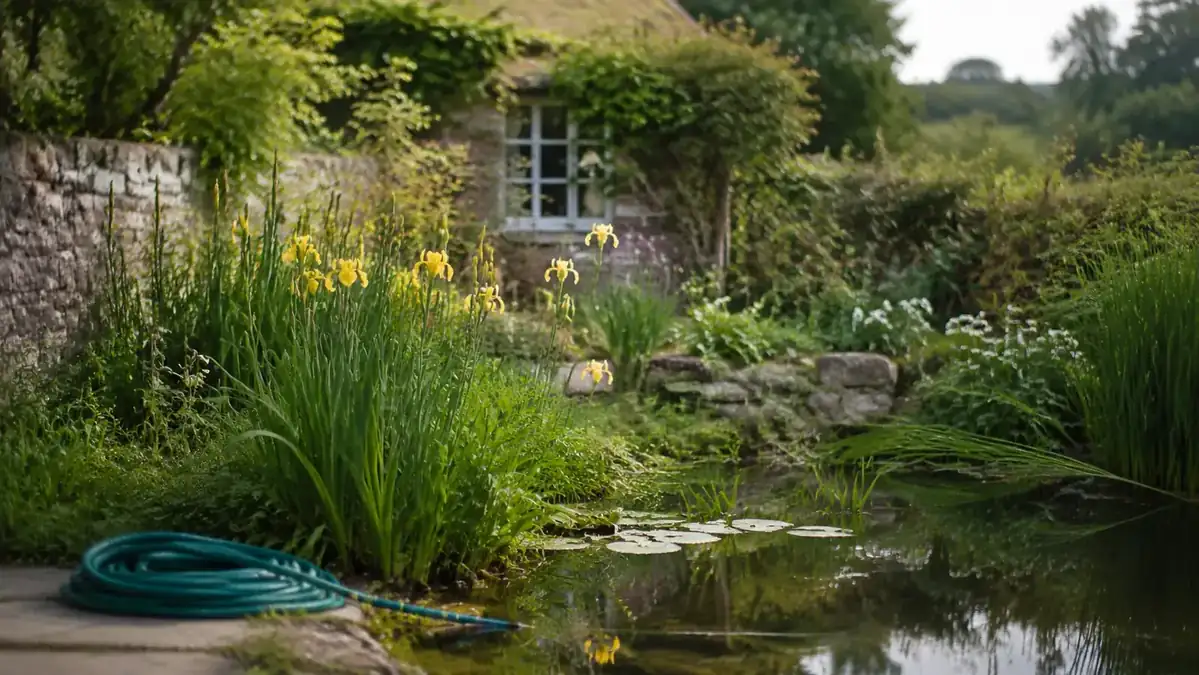
I made the mistake once. I was topping up the pond after a dry spell, hose in hand, and I let the tap run straight in without treating it first. Within twenty minutes my oldest koi, a twelve-year-old Kohaku I call Marmalade, was gulping at the surface and flicking her body against the liner. I knew immediately what I had done. Chlorine. It strips the protective mucus coat from a koi's gills and, at high enough concentrations, it starts to burn the tissue. That evening cost me a sleepless night and a fortnight of close observation. I will not make that mistake again, and I would very much like to spare you making it too.
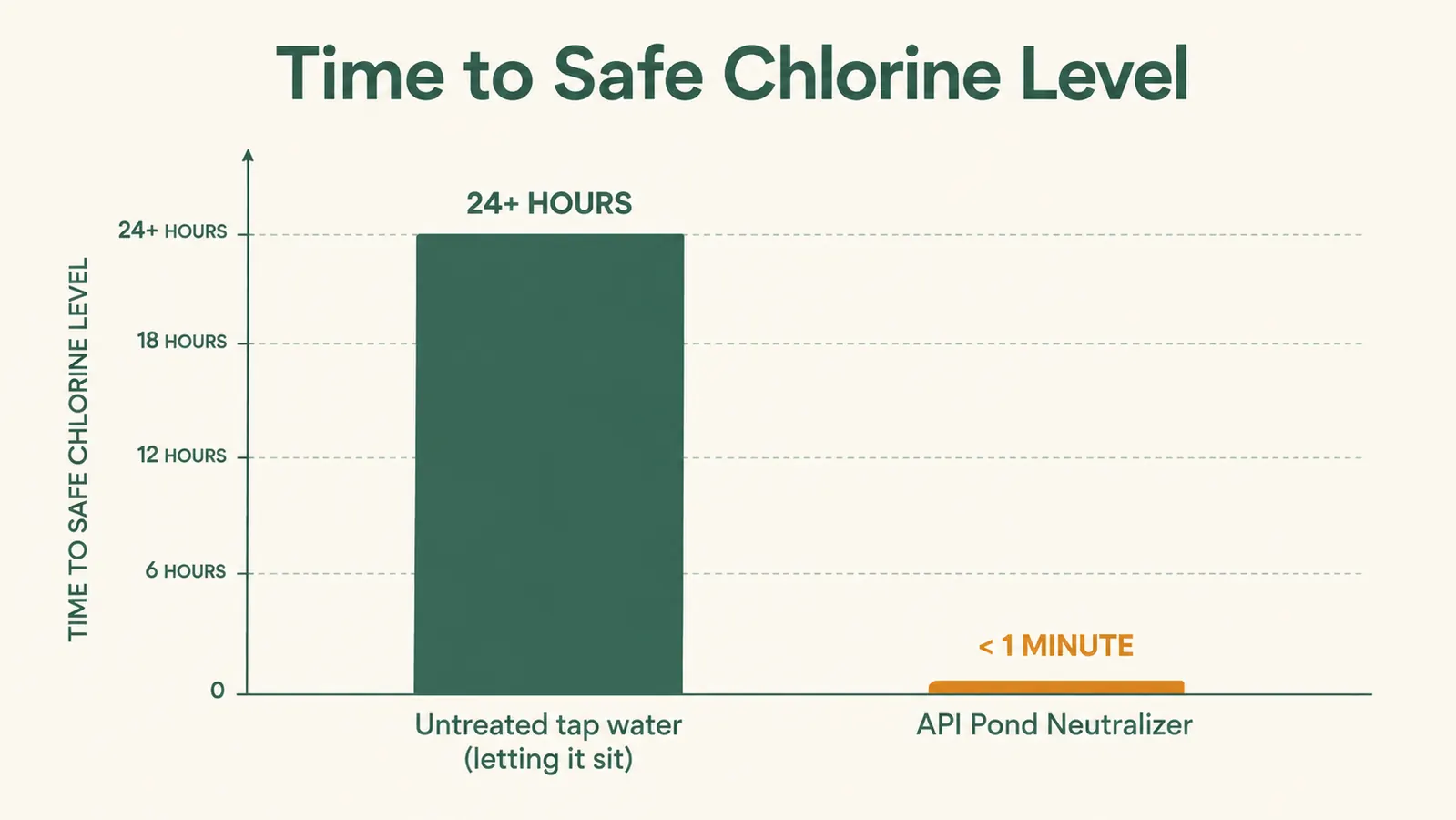
Dechlorinating pond water is not complicated, but it does require a reliable product and a clear process. Letting tap water sit out overnight is not good enough for a full water change. It takes twenty-four hours or more for chlorine to off-gas naturally, and chloramine, which many water companies now use instead, does not off-gas at all. You need a purpose-made pond conditioner that works instantly. The one I use, and have trusted for years, is API Pond Chlorine and Heavy Metal Neutralizer. After reading my full step-by-step below, you can also find my year-long review of the API product and a separate piece covering ten reasons untreated tap water is more dangerous than most people realise.
Before you turn that hose on, make sure you have this in your hand
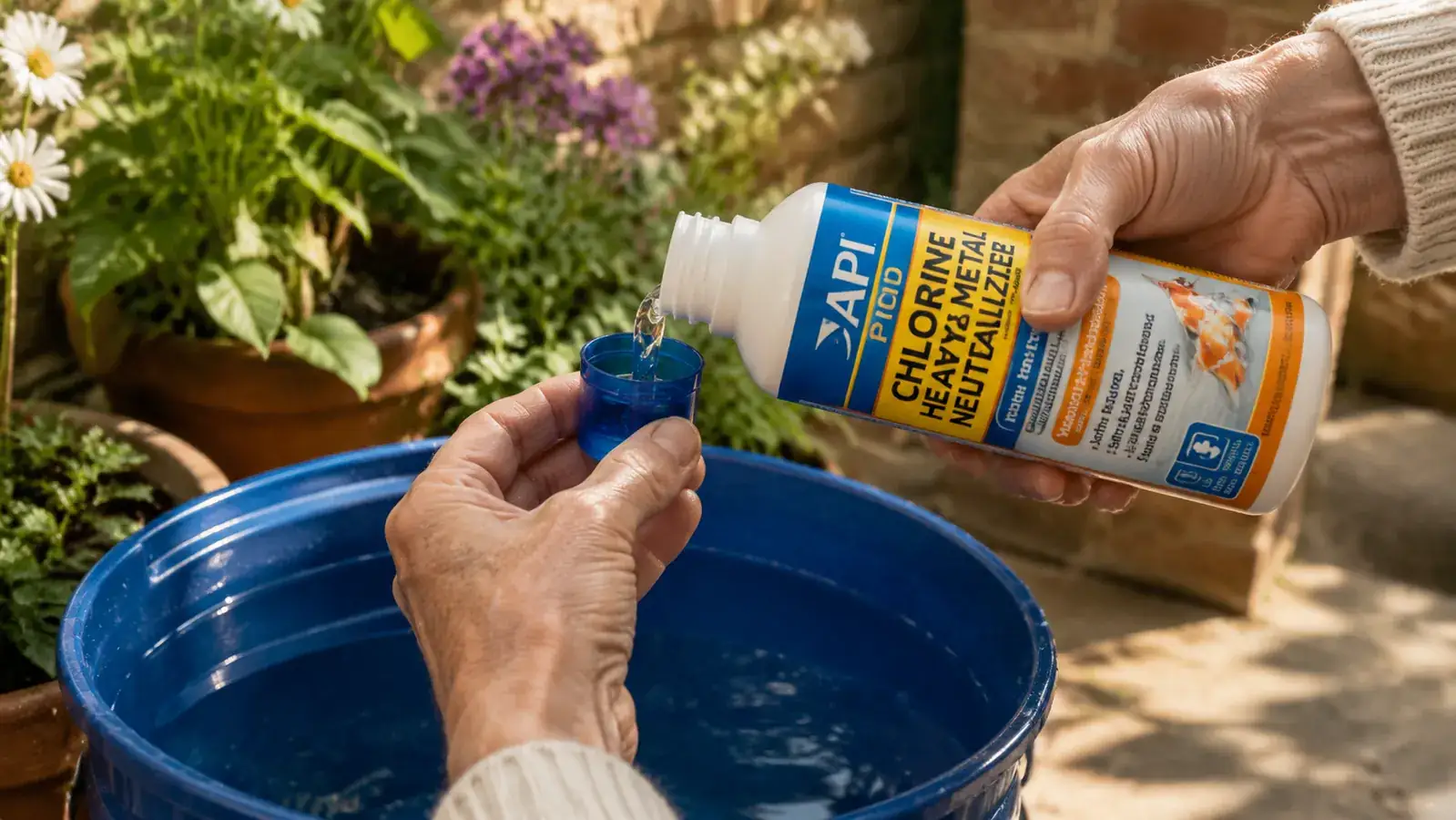
API Pond Chlorine and Heavy Metal Neutralizer neutralises chlorine and chloramine instantly and detoxifies heavy metals like lead and copper that come through old pipes. It is the one bottle I never start a water change without. Rated 4.8 stars from nearly 1,900 pond keepers.
Amazon Check Today's Price on Amazon →Why Dechlorination Cannot Wait
Tap water in the UK and most of the United States is treated with chlorine or chloramine to make it safe for human drinking. That is entirely sensible for us. For koi and goldfish, it is another matter. Chlorine damages the gill epithelium, the delicate tissue through which fish extract oxygen from water. Even brief exposure causes irritation. Prolonged exposure, or high concentrations during a large water change, can cause irreversible gill damage or death. Beyond the fish themselves, chlorine also kills the beneficial bacteria living in your filter media. Those bacteria convert ammonia and nitrite into the far less harmful nitrate. Wipe them out with untreated tap water and you can trigger a mini-cycle that spikes ammonia levels for weeks.
Heavy metals are the second problem most people overlook entirely. If you live in a house built before 1970, there is a real chance your supply pipes contain lead. Copper pipes, which are common in older cottage properties, leach copper into water that has been sitting still overnight. Neither lead nor copper is good for fish. A quality pond conditioner neutralises both at the same time as it handles the chlorine, which is why I choose a product that covers all three rather than a basic chlorine-only treatment.
Step 1: Test Your Tap Water Before You Begin
Before your first-ever water change at a new property, or if you move to a new house, run a quick tap water test. A basic API test kit will tell you your chlorine level, pH, and hardness. This gives you a baseline and confirms whether your supplier uses standard chlorine or chloramine. You can usually find this information on your water company's annual water quality report, too. Search your supplier's name alongside 'annual water quality report' and they are required to publish it.
The reason this step matters is dosing. The standard dose on most pond conditioners is calculated for a water supply with typical chlorine levels. If your tap water is unusually high, particularly after heavy rain when water companies sometimes increase treatment, you may need to dose slightly higher. The instructions on the API Pond Neutralizer bottle give you the standard dose plus guidance for high-chlorine situations. I always read the label afresh at the start of each season, because water chemistry can shift.
Step 2: Calculate the Volume of Water You Are Adding
You dose dechlorinator based on the volume of new tap water going into the pond, not the total pond volume. This is a point that trips up new pond keepers regularly. If your pond holds 2,000 litres but you are only doing a twenty-percent water change, you are adding 400 litres of new water. That is what you dose for. The API Pond Neutralizer label gives the dose per litre and per gallon, so have your pond volume written down somewhere convenient. If you are not sure of your pond volume, the quick calculation is length (metres) x width (metres) x average depth (metres) x 1,000. That gives you litres.
For top-ups after evaporation, which are common in warm summers, estimate how many centimetres the water level has dropped and multiply by your pond surface area in square metres. Again, you only dose for the water you are adding. For most routine top-ups in my own pond, that works out to somewhere between 100 and 300 litres, well within what a 32-ounce bottle of API Neutralizer will handle across an entire season.
Step 3: Measure and Treat the Water Before It Enters the Pond
This is the step that matters most, and the one most people either skip or rush. The safest method is to treat the water in a large holding container first, then pump or pour it into the pond once the dechlorinator has had a moment to work. I use two 200-litre food-grade water butts for this purpose. I fill them from the tap, add the measured dose of API Pond Neutralizer, give the water a gentle stir, and leave it for two to three minutes before pumping it across.
If you are adding water directly through a hose, which is perfectly workable for smaller top-ups, add the dechlorinator to the pond water in the area where the hose enters before you start the flow. The product neutralises chlorine on contact, so the treated water in that area will mix with incoming tap water as it arrives. I add a slightly larger dose in this scenario, perhaps ten percent more, to give a comfortable safety margin. The API Neutralizer is quite concentrated, so this adds very little to the cost.
The one method to avoid is adding dechlorinator to the pond after all the untreated tap water is already in. Even though a good product works fast, those first few minutes of untreated water in contact with your fish and filter are doing damage. Treat first, then add the water.
Step 4: Check the Temperature Before You Add New Water
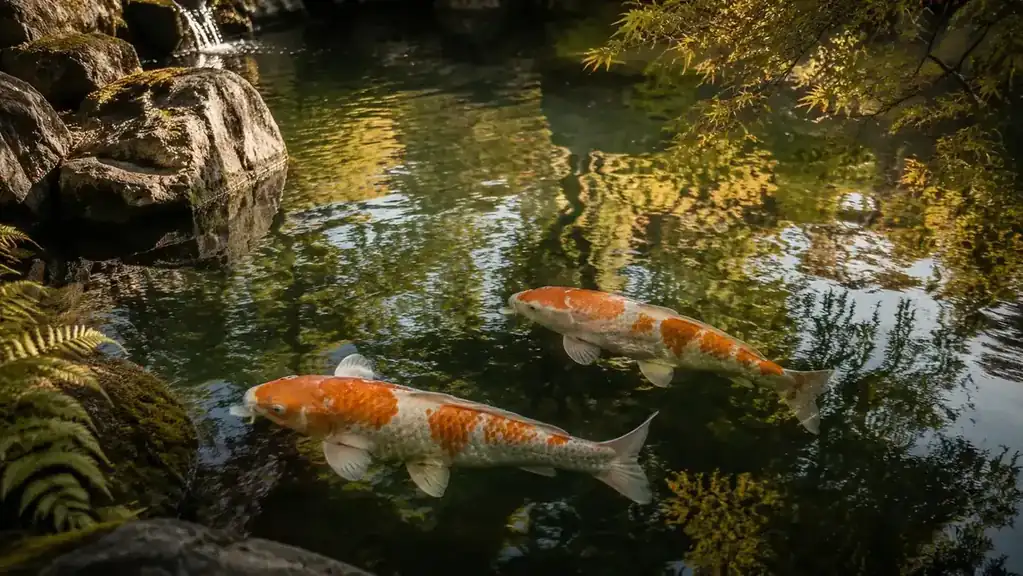
Cold-shocking koi is almost as stressful as chlorine exposure. If your pond has warmed to 18 degrees Celsius over a summer afternoon and you run cold mains water straight in, the sudden temperature drop can send your fish into shock. This is particularly dangerous for larger koi, whose metabolism and immune response are already stretched in warm weather.
A simple pond thermometer costs very little and takes the guesswork out completely. Aim for new water that is within three degrees Celsius of your existing pond temperature. In practice, this means filling your holding butt in the morning and letting it sit in a shaded spot for a few hours before adding it to the pond in the afternoon. In winter, the reverse applies: mains water is often warmer than pond water in very cold snaps, so check before you rush things in either direction.
The single most important rule of a safe water change is this: treat the tap water before it touches your fish. Everything else is secondary.
Step 5: Monitor Your Fish for the First Hour After the Water Change
Even when you have done everything correctly, a water change is a mild stressor for pond fish. The change in chemistry, however slight, prompts a brief adjustment. Spend a few quiet minutes by the pond after you have finished. Look for normal behaviour: fish swimming steadily at mid-depth or near the surface at feeding time, no frantic darting, no clamped fins, no fish sitting on the bottom and refusing to move. Any of these signs warrants attention.
If you do notice distress, the first thing to check is whether you dosed the dechlorinator correctly. A quick recheck against the label and your water volume calculation will usually settle the question. If you are confident the treatment was right and the fish are still unhappy, test your pond water. Ammonia and nitrite are the two most likely culprits, especially if the water change was large enough to disturb the filter bacteria. Keep a bottle of ammonia detoxifier on your shelf for emergencies. It buys your filter time to recover without harming the fish.
What Else Helps Keep Water Changes Safe
Routine is everything with pond keeping. I do a fifteen-percent water change every week throughout the growing season, which keeps nitrate levels stable and means I am never adding a large volume of new water in one go. Smaller, more frequent water changes are gentler on fish, gentler on filter bacteria, and easier to manage than infrequent large changes. If you have been neglecting water changes and feel the need to do a big one, break it into two or three sessions over a week rather than doing it all at once.
Keep a dedicated notebook by the pond. Write down the date of every water change, the volume added, the dose of dechlorinator used, and any observations about fish behaviour. Over a season you will start to see patterns: which weeks the fish are most active, when nitrate tends to creep up, when you need to increase feeding. That notebook has been worth more to me than any piece of pond equipment I have ever bought. It costs nothing and it turns guesswork into knowledge.
If you are curious about the broader picture of why tap water chemistry matters so much to koi, my piece on ten reasons untreated tap water harms koi goes into detail on chloramine, pH swings, and heavy metal accumulation that do not show up in a simple visual inspection of your pond. And if you would like a deeper look at how the API product performs across an entire year of use, my long-term review covers dosing accuracy, bottle concentration, and how it compares to leaving water to stand.
One small bottle stands between your tap water and your fish
API Pond Chlorine and Heavy Metal Neutralizer treats up to 9,464 litres per 32-ounce bottle at the standard dose. That is a full season of weekly water changes for most garden ponds, at a cost that works out to pennies per treatment. A 4.8-star rating from nearly 1,900 pond keepers is not an accident.
Amazon Check Today's Price on Amazon →