

I want to tell you something I wish someone had told me thirty years ago, before I learned it the hard way at the edge of a pond full of distressed fish. API Pond Chlorine and Heavy Metal Neutralizer is a good product. It genuinely works. But if you read the label, follow the directions, and assume that is the whole story, you are missing three things that nobody in the five-star review section ever mentions. I have kept koi for thirty years in a pond that started as a modest 800-litre dip in my cottage garden and is now a 4,500-litre feature I built over two summers with my late husband. I have made every mistake there is to make with this bottle. What follows is the honest account I could not find when I first bought it.
The Quick Verdict
API Pond Chlorine Neutralizer does what it says on the label, provided you understand what the label is actually promising. It neutralises chlorine and heavy metals quickly and reliably. It does not, on its own, fully address chloramine. That distinction matters more than any star rating.
Amazon Check Today's Price →Your tap water may be treating your koi as an afterthought. API is not a complete solution, but it is a reliable starting point.
If you are using untreated tap water in any volume during a water change, you need this on your shelf. The question is whether you are using it correctly.
Amazon Check Today's Price on Amazon →How I Have Used It and What I Have Tested
I do a 20 to 25 percent water change on my pond every ten to fourteen days between April and October, depending on bioload. I have six adult koi and four golden orfe, the largest koi being Margery, a fourteen-year-old kohaku who weighs close to four kilograms. When koi reach that age and size, any water quality stress is immediately visible in their behaviour: they slow down, they flash, they move to the deepest corner. Margery is my early warning system. API Pond Chlorine Neutralizer has been part of every water change I have done for the past four years, ever since I switched from a different brand.
I use a test kit every single time I top up the pond. I test for chlorine before I dose, immediately after I dose, and then again after twenty minutes. That habit is what revealed the first thing nobody tells you about this product.
The Chloramine Problem Nobody Mentions on the Amazon Listing
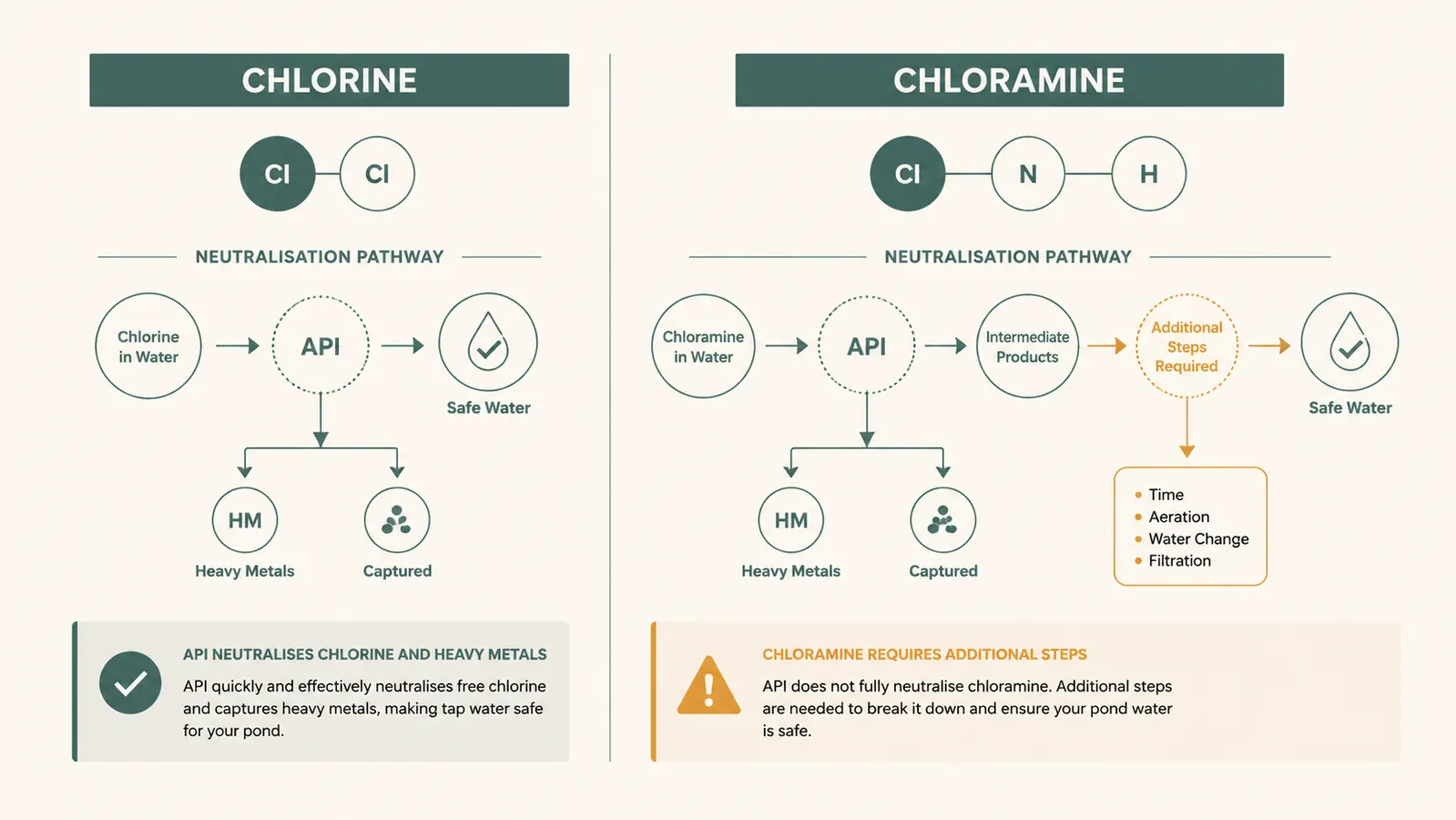
Most UK water authorities have now added ammonia to their chlorine disinfection process. The resulting compound is called chloramine. It is more stable than chlorine, which is why water companies prefer it: it does not dissipate as quickly during treatment and distribution. The problem for pond keepers is that chloramine is not the same as chlorine, and the two require different approaches to neutralise.
The API bottle tells you it neutralises chlorine and heavy metals. It does. But chloramine requires a product that specifically breaks the chloramine bond, separating the chlorine and ammonia so both can be addressed. API Pond Chlorine Neutralizer addresses the chlorine component of chloramine, which is better than nothing, but it leaves the ammonia fragment behind. In a mature pond with an established biological filter, your beneficial bacteria will process that ammonia relatively quickly. In a new pond, or after any event that has disrupted your filter, that residual ammonia can and does cause fish stress.
Chloramine is not chlorine with a longer name. It is a different molecule. A product that neutralises chlorine may only neutralise part of chloramine. Check what your water authority actually uses.
You can find out whether your local water authority uses chloramine by visiting their website and searching for their water quality reports. I found out my own supplier switched to chloramine in 2019, which retrospectively explained some puzzling ammonia spikes I had been seeing and attributing to overfeeding. The fix, once I understood the issue, was straightforward: I began adding a small dose of Seachem Prime alongside the API neutralizer on the days my ammonia readings were higher than usual. But I wasted nearly eighteen months not knowing to do this, and I suspect a number of pond keepers are in the same position right now.
The Dosing Mistakes That Catch New Pond Owners Out
The label instructs you to treat the full volume of your pond each time, not just the volume of new water you are adding. This seems counterintuitive and many people, quite reasonably, only dose for the amount of tap water going in. I understand the logic: if you are adding 900 litres to a 4,500-litre pond, surely you only need to treat 900 litres?
The reason the manufacturer recommends treating the full volume is dilution and mixing. When tap water enters a pond, it does not immediately mix uniformly. There can be pockets of higher chlorine concentration, particularly near the inlet point, and koi do not know to avoid those pockets. Treating the full volume provides a safety buffer throughout the water column from the moment new water begins entering. I follow this instruction now without exception. It costs slightly more product per water change, but it is the correct approach.
The second dosing mistake I see mentioned repeatedly in pond keeper forums is adding the neutralizer after the water change rather than before or during. The safe sequence is this: add the neutralizer to the pond before or as the tap water begins to flow. Do not let untreated tap water sit in contact with your fish for even a short while before dosing. Chlorine acts quickly. Koi gill tissue is sensitive. The order of operations matters.
A third mistake that surprises people: underdosing when in a hurry. The temptation, particularly on a busy afternoon, is to pour in a rough measure and assume it will be close enough. Chlorine neutralisation is not forgiving of approximation in the same way that, say, a fertiliser application might be. A dose that is 20 percent short is a dose that leaves measurable chlorine in the water. I keep a dedicated measuring jug next to my water change equipment and treat the dosing step the same way I would treat a medication: measured, recorded, consistent.
Why Some Ponds Still Lose Fish After Using This Product
This is the part of the review I find most important to write, because it is the question behind some of the more distressing one-star reviews the product receives. People who have used API Pond Chlorine Neutralizer correctly and still lost fish are not imagining things. The product has genuine limitations, and conflating those limitations with product failure only muddies the water for everyone else.
Three common reasons koi die even when a dechlorinator has been used correctly. First: the pond was already under stress before the water change. A fish that is fighting a bacterial infection, has gill flukes, or is in a pond with poor oxygen levels is much less able to tolerate even small spikes in water quality. A water change is supposed to reduce stress, but if the fish are already compromised, the physical process of a water change can itself tip them over. The dechlorinator did its job. The underlying problem did not.
Second: temperature shock. Adding cold tap water to a warm summer pond causes thermal stress that damages gill membranes, making fish more susceptible to pathogens and less able to tolerate chemical residuals. I let my hose run into a large clean bucket and allow it to warm for twenty minutes in summer before it goes into the pond. It slows the water change considerably, but it protects my fish. Third, and as already described: chloramine. If your water authority uses chloramine and you are using only this product, you may have residual ammonia entering your pond on every water change. That chronic low-level stress accumulates over weeks and months, and eventually a fish that should have been fine is not.
The Smell and Appearance: Honest Notes
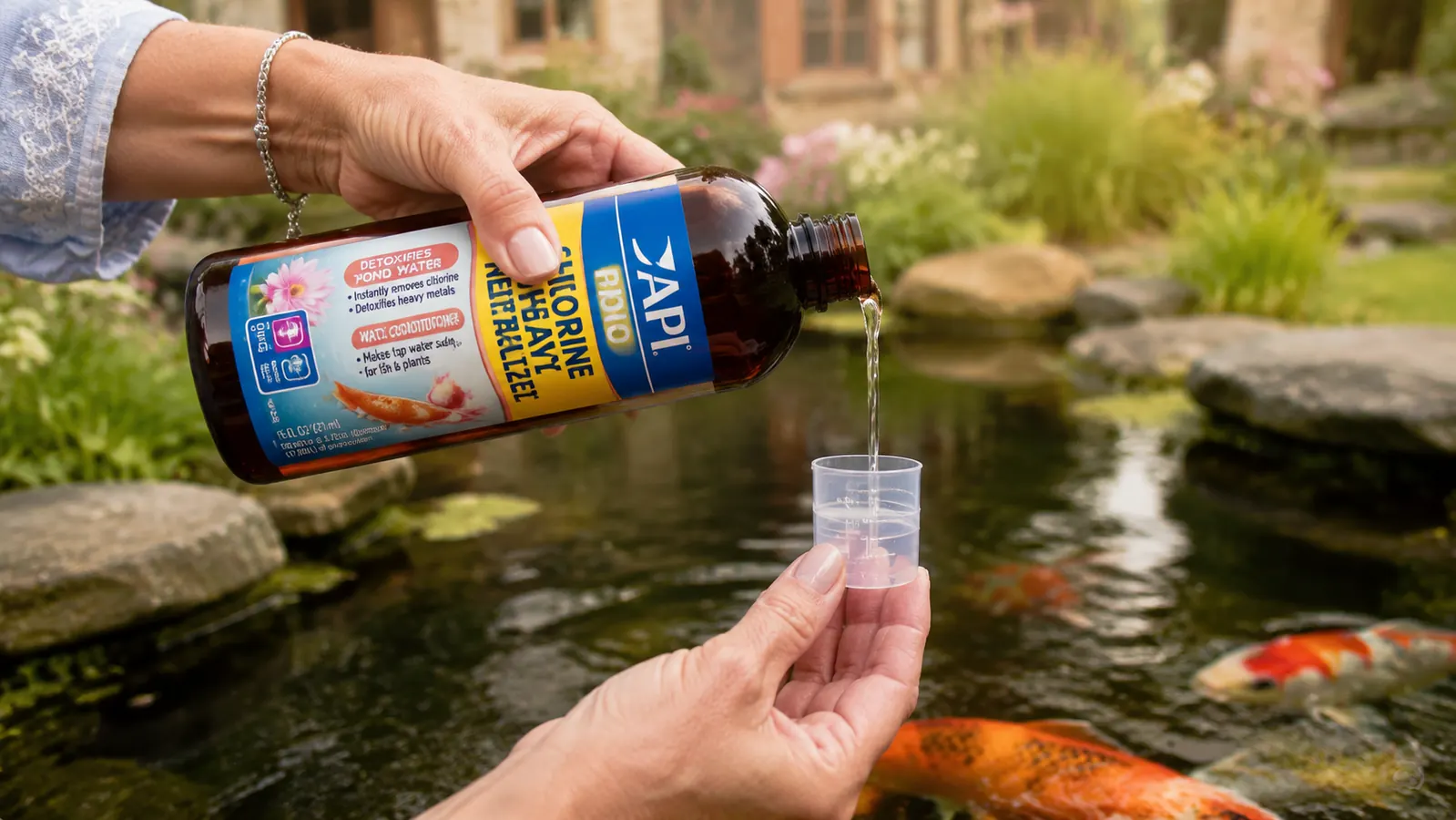
The liquid in the bottle is a pale straw-yellow colour with a faintly chemical smell, similar to a mild sodium thiosulphate solution, which is essentially what it is. The smell does not linger in the garden after application. It dissipates within a minute or two. I mention this only because I have seen people online express concern about the colour and scent of the product, wondering if it has spoiled. It has not. That is simply what it looks and smells like.
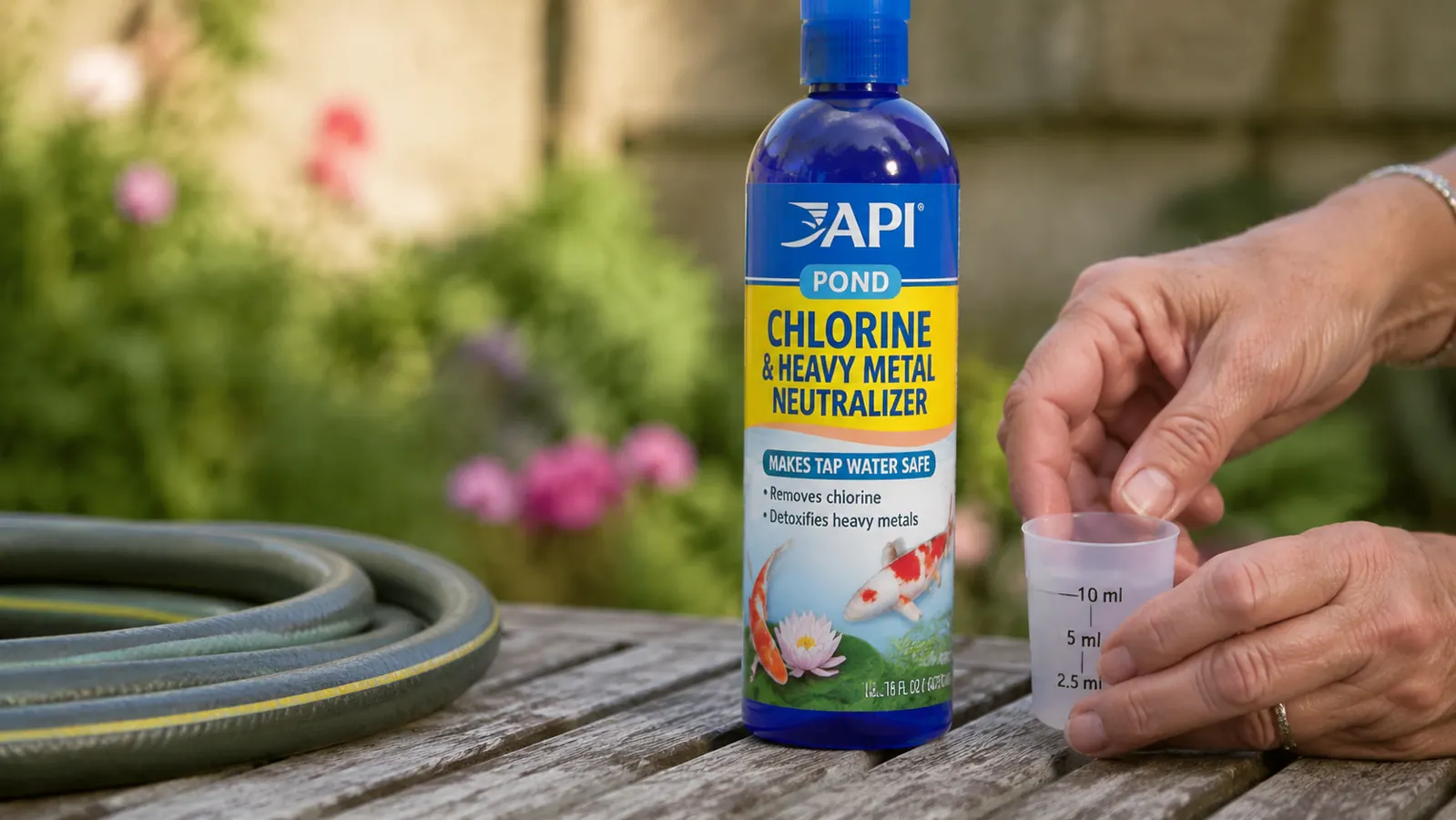
The bottle itself is a 32-ounce amber plastic bottle with a screw cap and a measuring cap. The measuring cap is modestly sized and requires some care to read accurately, particularly in outdoor light. I decant the amount I need into a small glass measuring jug before each water change, which gives me a clearer reading. The product keeps well. I have never had a bottle deteriorate before I finished it, and I store mine in a cool shed away from direct sunlight. One 32-ounce bottle at my pond size lasts me roughly six weeks of fortnightly water changes when I follow the full-pond dosing instruction. That is worth factoring into your ongoing cost if you are comparing it to more concentrated alternatives.
How This Compares to What I Used Before
Before switching to API, I used a supermarket-branded pond treatment for several years. The price was slightly lower per bottle. I switched when I had a run of minor fish losses that I traced, after a good deal of investigation, to inconsistent treatment potency in my previous product. I do not want to name another brand negatively, but the consistency and the brand history behind API gave me confidence I was not getting elsewhere.
The comparison that matters most to serious pond keepers is API versus Seachem Prime, which is the other product I get asked about frequently. Prime works differently: it detoxifies chloramine more completely, and it temporarily detoxifies ammonia and nitrite in emergencies. It is more concentrated, so the cost per gallon is lower despite the higher bottle price. I use both. API is my standard weekly dechlorinator; Prime comes out when I have a water quality emergency or when my ammonia readings suggest a chloramine issue. If I could only keep one product on my shelf, I would keep Prime. But API is more accessible, available in more outlets, and does its specific job reliably. For a full side-by-side breakdown of these two products, my comparison article looks at the numbers in detail.
What I Liked
- Neutralises chlorine rapidly, with results visible on a test kit within minutes of dosing
- Also addresses heavy metals, which is genuinely useful in areas with older pipe infrastructure
- Widely available and easy to find when you need it in a hurry
- Consistent potency across bottles, which matters when you are relying on it for fish safety
- Clear dosing instructions on the label, even if they require understanding to apply correctly
- Stable shelf life, stores well in a cool shed for months without degradation
Where It Falls Short
- Does not fully address chloramine, which is now used by most UK water authorities
- Full-pond dosing instruction increases ongoing cost compared to treating only new water volume
- Measuring cap is fiddly to read accurately outdoors, particularly on bright days
- Provides no ammonia detoxification, so offers no protection during filter crashes or cycling issues
- Does not buffer pH or add beneficial bacteria, meaning it is a single-purpose product
Who This Product Is For
API Pond Chlorine Neutralizer is the right choice if you are a pond keeper who wants a reliable, straightforward dechlorinator for regular water changes and who has a mature, well-established biological filter that handles ammonia efficiently. It is also well suited if you live in a water authority area that uses chlorine rather than chloramine, which you can verify in about five minutes online, or if you are already using it alongside a separate product that handles the chloramine component. It is an excellent product when used with an accurate understanding of what it does and does not do.
Who Should Look Elsewhere, or Add to It
If you are setting up a new pond and your filter is not yet cycled, this product alone will not protect your fish from ammonia, whether from chloramine residues or from the cycling process itself. You need something that temporarily detoxifies ammonia during that period. If your water authority uses chloramine and your filter is under any kind of stress, consider pairing this product with a chloramine-specific treatment. And if you are doing large emergency water changes to address a water quality crisis, this product will handle the chlorine but will not give you the ammonia and nitrite detoxification that a product like Prime can provide in those moments. For a step-by-step guide to doing a safe water change from start to finish, including how to calculate your dose correctly, my guide to dechlorinating pond water covers the full process I follow with my own pond, including what to do when things go wrong.
Thirty years of koi keeping taught me that the right product used correctly is worth more than the best product used wrong.
API Pond Chlorine Neutralizer is not the only dechlorinator you will ever need, but it is a solid, dependable one. Keep it on your shelf, understand its limitations, and your fish will thank you.
Amazon Check Today's Price on Amazon →